Television has been a powerful medium for educating and inspiring viewers about the wonders of the natural world.
Over the years, numerous programs have played a pivotal role in fostering America’s love of nature. From the pioneering days of “Mutual of Omaha’s Wild Kingdom” to the modern-day adventures of “Wild Kratts,” these shows have entertained, educated, and inspired generations of viewers.
Here are five programs I believe have had a major impact on America’s love of wildlife.
Mutual of Omaha’s Wild Kingdom
“Mutual of Omaha’s Wild Kingdom” is often considered one of the earliest and most influential nature television programs in the United States. Premiering in 1963 and hosted by Marlin Perkins and Jim Fowler, the show took viewers on breathtaking journeys into the world’s wildest places. What set “Wild Kingdom” apart was its groundbreaking approach to wildlife documentary filmmaking, bringing the excitement of nature into American living rooms.
Marlin Perkins, as the host, offered insightful commentary while Jim Fowler undertook daring expeditions, often getting up close and personal with animals. This program made nature accessible and fascinating to a broad audience, encouraging viewers to appreciate and protect the environment. “Wild Kingdom” helped lay the foundation for future wildlife programs and played a significant role in shaping America’s love of nature.
Wild America
“Wild America,” hosted by Marty Stouffer, debuted in 1982 and showcased the diverse and breathtaking landscapes of North America. The show primarily focused on the wildlife and natural beauty found in the United States, making it relatable to American viewers. Marty Stouffer’s passion for the outdoors and his engaging storytelling drew audiences into the world of animals and their habitats.
One of the key strengths of “Wild America” was its stunning cinematography, which captured the beauty and grandeur of America’s national parks, forests, and wilderness areas. By showcasing the incredible biodiversity of the continent, the show instilled a sense of pride and awe in viewers, fostering a deeper connection to nature and a desire to protect it.
Grizzly Adams
“Grizzly Adams” was a television series that ran from 1977 to 1978, based on a real-life character named John “Grizzly” Adams. This show told the story of a man who fled from the law into the wilderness, where he formed a unique bond with a grizzly bear named Ben. Through their adventures, the program conveyed themes of friendship, wilderness survival, and respect for nature.
While “Grizzly Adams” may not have been a documentary-style nature program like the others on this list, it played a crucial role in promoting a romanticized view of the American wilderness. By showcasing the harmony between man and nature, the show inspired viewers to appreciate the beauty and tranquility of the natural world.
The Crocodile Hunter
“The Crocodile Hunter,” hosted by the charismatic Steve Irwin, burst onto the scene in the late 1990s and quickly became a global sensation. Steve Irwin’s boundless enthusiasm and fearless approach to handling dangerous animals made him a beloved figure in the world of wildlife television. His catchphrase “Crikey!” became synonymous with his adventurous spirit.
The show took viewers on adrenaline-pumping expeditions to various corners of the world, where Steve and his wife, Terri, interacted with and educated audiences about a wide range of wildlife, including crocodiles, snakes, and spiders. Steve’s infectious passion for conservation and his ability to make even the most intimidating creatures endearing endeared him to audiences of all ages. His untimely death in 2006 was a profound loss for the world of wildlife television, but his legacy continues to inspire a love for nature and a commitment to its preservation.
Wild Kratts
“Wild Kratts,” a children’s animated series, premiered in 2011 and has since become a beloved show for young nature enthusiasts. The series is hosted by real-life brothers Chris and Martin Kratt, who use animated avatars of themselves to embark on incredible adventures to explore the animal kingdom. Along the way, they educate young viewers about the unique abilities and behaviors of various animals.
What sets “Wild Kratts” apart is its focus on science education and its ability to make learning about nature fun and engaging. The Kratt brothers incorporate STEM (science, technology, engineering, and mathematics) concepts into their adventures, teaching children about animal biology, ecology, and conservation in an accessible way. The show’s combination of animated action and real-life footage of animals creates a captivating and educational experience that has played a significant role in shaping a new generation’s love of nature.
Television programs have played a crucial role in influencing America’s love of nature by bringing the wonders of the natural world into our homes. From the pioneering days of “Mutual of Omaha’s Wild Kingdom” and the breathtaking landscapes of “Wild America” to the adventures of “Grizzly Adams” and “The Crocodile Hunter,” these shows have ignited our passion for the environment.
Today, “Wild Kratts” carries on the tradition of inspiring young nature enthusiasts and fostering a deep appreciation for wildlife and conservation. These five programs have not only entertained us but also educated us about the incredible diversity of life on Earth and the importance of preserving it for future generations. Through their impact, they have contributed to a collective commitment to protect and cherish the natural world.
Follow Chester Moore and Higher Calling Wildlife® on the following social media platforms
It kicks off with an eight-part series on the black panther phenomenon with episode one tackling the topic of escaped exotics and the infamous stories of circus train wrecks.
You can watch the episode below. Please subscribe to our channel.
The next episodes will cover the following topics.
*Black Mountain Lions
*The Jaguarundi
*Black Bobcats
*Feral House Cats
*The Black Longtail
*Jaguars
*Hybridization & Other Strange Theories On Black Panthers
Don’t miss the series kick-off and stay tuned for weekly episodes of Higher Calling Wildlife on Youtube.
Follow Chester Moore and Higher Calling Wildlife® on the following social media platforms
We hope you get to spend it with people you love and eating too much good food.
Please take time to reach out to those who might be lonely this Christmas.
A phone call or a text to say “I love you” or “Merry Christmas (Insert Name)” might save a life. Suicide rates are through the roof around Christmas.
I’m excited for 2024 as we have a lot of really great things planned with some of the content you all have been asking for more of over the last year.
Feel free to share my kid’s story and its animated video “Bingo the Christmas Dingo” with the kids in your life. We got to read the story to a foster group home this morning and it blessed my heart seeing the kid’s reaction.
I’ll be back soon with new in-depth wildlife posts, videos and podcasts.
May the peace of Christ be with you and yours!
Chester Moore
Follow Chester Moore and Higher Calling Wildlife® on the following social media platforms
Christmas is a time of joy, celebration, and time with family.
But for many, it’s a dark time of isolation and loneliness, especially when it brings back memories of a dearly departed loved one.
I’ve had my brush with this and remember the date clearly. It was Dec. 27, 2014.
No place is more alive just before dark than the cactus-filled thickets of deep South Texas and that’s where me and my Dad were hunting.
I had to talk my Dad into duck hunting but he loved deer hunting and instilled in me a conservation ethic through our time in the field.
My father and I were hunting our friend Robert Scherer’s ranch near Freer and I was absolutely stunned by the number of big bucks, young bucks, does and other creatures I spotted.
A stunning green jay sang just outside the tower blind I sat in while a long-legged bobcat carefully moved down the sendero.
The scene’s highlight was a massive drop-tined 10-pointer that looked like something out of a deer hunter’s dream. I was there to shoot does for the freezer but had as much fun filming and photographing the behemoth as I would have shooting it.
Truly majestic.
The previous evening, Dad shot a beautiful 18-inch eight-pointer that was his second biggest buck, only behind a three-main-beamed monster he bagged at the same ranch two years earlier.
“That is a nice buck. I’m so happy for you,” I told Dad as I showed him a photo of it on my phone.
“Yeah. It is nice,” he replied with a smirk.
“See anything this evening, Dad?”
“A few does and a bunch of javelina, 15 of them,” he replied.
Dad then explained that a group of 14 javelinas came out and fed on the corn scattered down the Sendero and that he raised his rifle to shoot one but just couldn’t do it.
“I really didn’t want to shoot a javelina and learned years ago not to shoot anything that I did not want to eat,” he said.
“So, I decided to get some photos for you, but when I positioned the camera, they all left.”
“Then something interesting happened,” he said.
“A lone javelina that had not been part of their group came out and virtually posed for me and let me take several good shots.”
My Dad with the buck he shot the night before he passed away.
Dad then turned on his camera and showed me some nice photos as a big smile came across his face.
“I believe that was God’s way of showing me I did the right thing.”
“How awesome is that, Dad? God has shown us some amazing signs in nature, hasn’t He?” I replied.
We briefly spoke about that and then decided to quarter his buck hanging in Scherer’s freezer.
While cleaning the buck with another gentleman and his wife who were hunting the ranch, Dad suddenly said, “I think I overexerted myself.”
I walked over to help him from the squatted position, and he looked at me and said, “It’s not good.”
The couple who were helping us with the buck were EMTs, and they worked on Dad and kept his heart beating for a good while, long enough for me to tell him I was proud to be his son, that me, mom, my wife Lisa and his beloved granddaughter Faith loved him.
Soon after, Dad passed from this world into the arms of His Savior, Jesus Christ.
My head spun as I watched the man who introduced me to the great outdoors, supported everything I ever did, and loved me unconditionally, lifeless on the floor of the ranch house. I had to make some painful phone calls home and then make the seven-hour drive back to Orange.
Just as I left the ranch gates around 10 p.m., I came within a couple of feet of hitting a big boar javelina. Something about the animal seemed surreal, almost like I saw it in a strange 3-D projection.
As I drove down the lonely highway in my Dad’s truck, realizing I would never get to hunt or fish with him again, I cried in mourning for the man behind many of my successes in life.
Then I started praying.
“Lord, could you please send me a sign from Dad, a sign from you that He is alright?”
I knew without question where He was, but at that moment, not much seemed real. My life suddenly seemed like a terrible dream. And then it hit me.
I asked if he could hear me, and he blinked his eyes.
The javelina.
The javelina was my sign.
Our last conversation was about a lone javelina and how God used it to confirm that He made the right decision. Now it made sense why I got such a close look at the creature and why something about it seemed different.
I believe the javelina was heaven-sent.
That encounter boosted me to make the four-hour drive to an area where friends would meet me and take over the rest of the three hours.
IA lone javelina was the sign I needed.
I didn’t want to deer hunt for a couple of years after Dad passed away. I would duck hunt but shied away from deer hunting because that was the thing we shared so much together.
But that changed after I realized he would love to be deer hunting with me out there.
Since Dad passed away so close to Christmas, the holiday is always a reminder of his passing. But we have chosen it to be a reminder of a well-lived life and a man who brought us happiness.
Many of us who love the great outdoors have lost people, and this time of year, it can quickly turn to depression.
Choose to turn it into a celebration, and remember the reason for this season can bring you peace beyond understanding. I cried out to Him in deceleration for a sign on that sorrowful night, and He answered.
The world is going wild, and things can look grim, but focus on the good things in life.
Remember the incredible whitetails you hunt, the ducks you doggedly pursue, and the bighorns and elk you dream of.
Spend time with those you love, and always reach out to others who might be struggling this time of year.
Trust me, even after grief strikes, things can get better, and there’s no better place to feel that than in the great outdoors.
Give yourself the gift of the outdoors this year and share it with others. I had to take a long drive to get back to the place I could enjoy Christmas and I know you can do it as well.
You can change lives for the better by helping others hunt, fish, and enjoy nature, and you will honor those outdoors lovers who have fallen in the process.
Merry Christmas!
Chester Moore
Follow Chester Moore and Higher Calling Wildlife® on the following social media platforms
The smell of southern fried seafood hit my nostrils as I opened the door of my truck.
When I walked over to open the door for my girlfriend (now wife) Lisa, a huge mud-covered animal emerged from the marsh on the edge of the seafood restaurant’s parking lot.
At first, in the dim light, I thought it was a young steer as cattle are common in any pasture, wood lot or marsh in the area.
But it was no steer.
This was a hog, one that weighed well beyond 500 pounds. It was white and covered in mud.
It grunted heavily when it saw us (we were only 10 steps away) and then went on about its business of rooting up the ground.
The area the animal came from from marsh next to a large refinery facility. This is bordered by a large chip channel and a whole bunch of industrial buildings and homes.
Obviously that huge hog, perhaps a domestic set free to graze years ago as that used to be common in Southeast Texas. It does not take hogs long to go back to their wild origins and integrate into any purely feral hog populations.
This was not the only time I came across evidence of monster hogs in the area.
Early in my writing career a man told me had located a really big black boar in a wood lot behind the Vidor, TX Wal Mart and wanted to know if I wanted to tag along with he and his dogs to catch it.
I declined.
Two weeks later a letter arrives in the mail with a photo of the hog they killed, all 400 pounds of it. I later drove by the area to inspect and saw the 20 acre wood lot the beast had lived in amongst a city of 10,000.
Both of the aforementioned hogs were boars and large, solitary ones that can find enough woods to hang out during the day and vacant field, cattle pastures (common in southern cities) right of ways along highlines and drainage canals can thrive
Throw in the aforementioned practice of allowing domestic hog breeds like Yorkshires and Durocs feed on open range with cattle and you have an even bigger chance of huge hogs showing up. Hogs show little regard for fencing and also need no help from man to survive beyond captivity.
Hogs can get huge without hunting pressure in cities.
As hogs push deeper into urban territory, certain individuals will find these sanctuary areas that will allow them to grow to epic proportions.
Animal control offices throughout the South (and as far north as New Jersey) are contending with hogs now on a daily basis but monsters like these are unlikely to participate in any trapping program they initiate.
Without the gun as an option in these urban sanctuaries, those hogs with the genetic code to grow huge will, dethroning the coyote as the apex of city-dwelling wildlife.
Young pigs will provide coyotes food but the ones I am writing might just decide to make coyote their food.They are able and in some cases totally willing.
Right now there are sizable feral hog populations in Beaumont, Dallas-Forth Worth and Houston, in in my home state of Texas and also around Baton Rouge, La. and a number of sizable metro areas in Florida such as Tampa.
I believe what we are about to see is cities harboring some absolutely monster-sized hogs.
A 150-pound boar captured on a trail camera near a popular Southeast Texas fishing hole.
There is adequate habitat, food and cover and large boars in particular which tend to be solitary are great at remaining hidden. They may in fact possess more “intelligence” than any wild animal in North America.
Hogs are popular with hunters and in fact, have superseded whitetail deer as the most harvested animal in Texas with a whopping 750,000 new killed annually according to Texas AgriLife. Louisiana and Florida also support a huge hog hunting culture.
The fact that firing guns in city limits is a no-no will give hogs with monster genes the opportunity to live to maximum potential.
This is where it will get interesting.
Sightings will be elusive but these creatures will be seen perhaps in schoolyards near children or eating Fifi” the poodle as granny takes it for a stroll in the park.
How will the public react to seeing a boar just shy of average grizzly proportions (600 pounds) strolling down main street?
The one I saw as a teen coming out to sniff the seafood is a reminder this phenomenon did not start over the last decade. But hog numbers have exploded and their push into the cities has increased dramatically.
People need to be aware of their existence and while hogs are not out to get people, the killing of a woman in a yard in Anahuac, TX reminds us they are a legitimate danger.
Chester Moore
Follow Chester Moore and Higher Calling Wildlife® on the following social media platforms
On January 2016 an interesting story broke via KLTV out of Tyler., TX.
Landowner Mitchell Cox of Hughes Springs captured on video what he and many others thinks is a “white panther”.
“When I first saw the white animal, the first thing I thought was, it was a dog. I feel blessed to actually be able to see it,” said landowner Mitchell Cox in the KLTV story.
“The cat jumps across about a 6 foot creek there. At first, my initial thought was it was an edited video, but upon talking to people I believe it’s true. A white albino mountain lion,” investigator Hershel Stroman, of the Morris County Sheriff’s Office told KLTV officials.
The video is interesting and the animal moves like a cougar but without a closer video (this one was shot 50 yards away with a cellphone) it is difficult to tell.
The term “white panther” is rarely used and in this case it is a reference to what is believed to be a white cougar (mountain lion, puma). This might sound like a stretch but whether or not the 2016 video shows one, science has observed white cougars.
In 2011 a white cougar was born at the Attica Zoological Park in Greece and was aptly named “Casper” proving they are a possibility in nature. A 2013 trail camera photo from Sierra dos Argaos National Park shows a white cougar. It’s leucistic which means its white all over with the exception of the eyes. Leucistic tigers for example have blue eyes.
This photo shocked the world-a white puma (cougar) in Brazil. Image: ICMBio
In the mid 2000s there were several reports of a white cougar at Red Rock National Conservation Area near Las Vegas, NV. A “white panther’ is a truly rare animal.
Sightings of “black panthers” are commonly reported.
Many hunters, fishermen, birdwatchers, hikers and people of all walks of life reporting seeing large long-tailed black cats they label as “black panthers”.
The problems there is no such species as a “black panther” anywhere in the world.
What about the large black cats seen in zoos and on television programs?
Those are black (melanistic) leopards or black jaguars.
Melanism is when a hyper amount of black pigment dominates coloration of an animal. It happens in many animals ranging from squirrels to whitetail deer. Melanism is not uncommon in leopards in certain parts of their range as well as with jaguars.
The general assumption with “black panther” sightings i is that these are black or melanistic cougars. The problem is there has never been a melanistic cougar observed by science either in a zoo, captive setting, killed by a hunter, mounted by a taxidermist or otherwise positively identified.
And here we have two extremely rare white ones showing up in the span of a few years.
Is it possible that there could be black cougars? Yes, but not likely.
Now, those of us who appreciate wild cats, can marvel at the idea of a white cougar.
We know they exist.
Perhaps sometime in the future there will be validation of these cat on the other side of color spectrum.
Until then we can appreciate the fact these mysteries deepen peoples love of nature and hope that translates into conserving the habitat of the great cats.
Truly wild habitat in many areas of America is quickly becoming as elusive as the cats themselves.
I have been getting many requests for more video content and I have uploaded 75 videos (and counting) to my YouTube channel. You can help me in a major way by subscribing to that channel.
I’m trying to get to 1,000 subscribers so I can monetize and help feed the family in an increasingly challenging to make a living in media world. Your support is appreciated. This helps me and my family and will help the causes we support.
I have uploaded some killer stuff including videos of pink dolphins, bears in Oklahoma, wild cats, snakes eating snakes and much more. I also have a Dark Outdoors playlist with cool clips and a full documentary. I will be doing many Dark Outdoors clips as well as some (by popular demand) cryptozoology videos.
Please subscribe and comment away on the clips. Let me know what you want to see and I will do my best to make it happen.
Chester Moore
Follow Chester Moore and Higher Calling Wildlife® on the following social media platforms
@thechestermoore on Instagram
Higher Calling Wildlife on Facebook
Email Chester at chester@chestermoore.com.
Subscribe to the Dark Outdoors and Higher Calling Wildlife podcasts on all major podcasting platforms.
In 2007 I started a conservation project to raise awareness to the fact they are illegal to kill here and to get people bear aware so they can stay safe through Texas Fish & Game magazine.
Bears returning to Texas is a passion of mine.
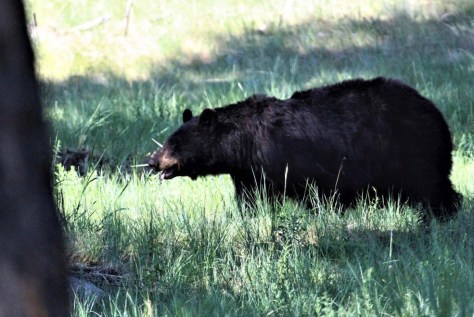
The author photographed this bear in Yellowstone in 2021.
Now let’s tackle the elephant in the room-the photo.
My gut feeling on photo when I saw it Thursday was it looked like a bear. I would like to see the head but I spoke with the gentleman who took the photo and he said he saw the head and believes it was a bear.
He seemed very credible to me as he described several attributes of bear movement and that he actually saw the full animal-unobscured by brush.
My thoughts were it’s either a bear or one of these really (for lack of a better term) fat feral hogs that pops up every once in awhile based on the photo-which I will not share here.
These massive hogs caught on a game camera set by Bobby Elder could be mistaken for a bear if the head was obscured. The author has seen hogs like this in recent years taken from a landfill area in Southeast TExas.
I believe the gentlemen who took the photo has had more than his share of mean-spirited comments about the photo and I don’t want to contribute to that.
The bigger point is this is a moment to get educated about a large carnivore that has already begun a good comeback in West Texas, parts of South Texas and are starting to pour over into Northeast Texas.
Here are some things people need to know about bears in East Texas.
1. Black bears are native to Texas. They are supposed to be here although like many things were extinct locally. Louisiana, Arkansas and Oklahoma all have bears and they have been proven to cross into East Texas. Louisiana has an expanding bear population in the south-central part of the state and two weeks ago issued a public comment period for a Louisiana black bear season (limited) in 2024. Subadult males in particular move great distances so while it’s rare to have one show up in our area, they should be here.
2. There have been zero bear stockings in Texas! While Louisiana in the distant past brought in bears from other states to help their herds genetic diversity, Texas has never stocked bears. These are not stocked bears.
3. Yes, black bears are potentially dangerous but feral dogs for example are far more likely to attack. Don’t freak out because of a potential bear sightings in Orange. With expansion in Louisiana it will eventually become more commonplace. I predict we’ll have fairly regular Southeast Texas sightings in a decade.
4. Read our article posted above to learn about what to do in the RARE instance of a black bear attack. Don’t worry about your dogs and cats being attacked. The hundreds of coyotes we have in Orange are a far bigger threat. And so are the roadways! Keep them in a fence.
5. They are a state-listed threatened species and illegal to kill. Leave them alone and don’t feed any bears you might come across. A fed bear ends up being a dead bear because they get too accustomed to people and have to be euthanized.
People who literally have no idea about wildlife should refrain from making public comments. I have heard things about black bears and Texas that are absolutely false.
People need to know bears are in Texas and although a rare sighting in Southeast Texas do show up.
I’ll leave you with this bear poster we started sending out through Texas Fish & Game back in 2007. You can get a .pdf of this by shooting me an email. I’ve been following the return of the bear to Texas for 20 years. It’s time people stop laughing about the idea of bears in Texas and get a clue.
The ugly side of wildlife social media rearer its head on this bear story and I propose we rejoice because wildlife got news coverage. Plus, there’s a very good chance a bear crossed into Orange County, TX.
How cool is that?
Chester Moore
Follow Chester Moore and Higher Calling Wildlife® on the following social media platforms
@thechestermoore on Instagram
Higher Calling Wildlife on Facebook
Email Chester at chester@chestermoore.com.
Subscribe to the Dark Outdoors and Higher Calling Wildlife podcasts on all major podcasting platforms.