Sheep Show Highlights Hope

A desert bighorn ram crossed the steep, rocky opening with incredible ease.

I had struggled to quietly get within photo range without slipping and falling to my death for longer than I would like to admit. The ram, however, crossed through a much more treacherous spot with impunity-in seconds.

IMG_0268
A beautiful desert bighorn ram walks across a steep, rocky slope. (Photo by Chester Moore, Jr.)

Seeing their ability to survive and thrive in such habitat is one of the things that draws men to seek out wild sheep-whether with a camera, rifle or bow and arrow.

And Jan. 15-17, thousands of sheep enthusiasts gathered in Reno, NV. at the annual Sheep Show hosted by The Wild Sheep Foundation.

It was my first time attending and I came both as a fan of wild sheep and a wildlife journalist wanting to get the story on what makes this group of people tick.

The fan was satisfied as soon as I walked through the doors of the Reno-Sparks Convention Center.

82667604_222918925387922_9194016390653149184_n
The author with a beautiful Dall sheep mount at the Wild Sheep Foundation’s Sheep Show in Reno, NV. (Photo by Chester Moore, Jr.)

Anyone into wild sheep would be impressed with incredible wild sheep taxidermy displays and hundreds of booths ranging from outfitters specializing in argali hunts in Tajikistan to Colorado’s grass-roots Rocky Mountain Bighorn Society.

IMG_3557 (2)
An incredible argali display created by Wildlife Revolutions-Taxidermy Studio. (Photo by Chester Moore, Jr.)

A melanistic desert bighorn taken in Mexico was of particular interest as well as a mountain-style display of wild sheep and goats from Asia.

IMG_3572 (1)
A melanistic desert bighorn taken in the 2019 season in Baja Mexico on a hunt arranged by Bo Morgan of Go With Bo, a well known outfitting company. (Photo by Chester Moore, Jr.)

Sheep hunting is not for the out of shape was evidenced by conversations with outfitters who start some of their hunts at upwards of 12,000 feet.

And it’s not for the out of work either.

While lottery-style draw permits gives the working-class man access to sheep hunting, much of it is a wealthy man’s game.

But that has come as a benefit to wild sheep.

Whereas whitetail deer can pay for themselves through standard hunting licenses fees due to their huge distribution and strong populations, sheep can’t survive through that model.

Auctioning off a portion of tags to wealthy hunters at banquets like those held at the Sheep Show funds a huge part of wild sheep conservation efforts. And whereas whitetail need studying and observation, sheep need an entirely different level of management.

Moving sheep from areas with high population densities to low and making sure they do not co-mingle with domestic sheep that can pass on the deadly pathogen M. ovi is incredibly expensive.

Without groups like The Wild Sheep Foundation which according to president Gray Thornton spent more than $6 million on conservation efforts in 2019 along with regional groups like the Texas Bighorn Society and Alaska Wild Sheep Foundation, sheep would be in real trouble.

Tags at these auctions regularly go more than $100,000 and some coveted tags like those for Montana’s giant rams have fetched more than $400,000.

The hunters with that kind of coin could easily hunt big rams with outfitters who have tags and spend less. But these hunters believe in conservation and don’t mind spending to make it happen.

The most impressive part of the event came at the beer reception for the Less Than One Club. It’s a subgroup of The Wild Sheep Foundation for members who have never taken a wild sheep.

More than 2,000 people attended this year’s event, shattering the previous record and showing an incredible diversity of people.

I’m a member and despite having traveled and written all over North America have never taken a sheep.

Neither had the lifelong sheep biologist who I sat with or the 28-year-old girl I met who dreamed of sheep hunting. Virtually very income level, background, ethnicity and state in the union was represented and everyone was truly excited.

IMG_3585 (1)
Pete Muennich of the Rocky Mountain Goat Alliance announces the winner of the annual “Billy Goat Club” drawing for a mountain goat hunt.  The Rocky Mountain Goat Alliance partners with The Wild Sheep Foundation on this event. (Photo by Chester Moore, Jr.)

And although I don’t have official demographics, I estimate a third of that room was 35 years and younger and half under 45. In the hunting world those are impressive numbers and they show hope for the future of wild sheep.

Enthusiasm for these great animals is not limited by age, income bracket or location. It’s universal to those who have somehow found a fascination with wild sheep.

Three Dall sheep hunts were given away that night in draws that had everyone on their edge of their seats. Asian ibex hunts were given away for the international component of this unique club that everyone in the room inherently wants to be disqualified from.

The day after the show, I drove seven-hour span from Reno to Las Vegas to attend the SHOT Show on behalf of Texas Fish & Game magazine. It was an incredible drive through stunning country with frequent “Bighorn Crossing” signs.

IMG_3674
Bighorn crossing signs are a common sight in many areas of Nevada, highlighting the state’s high level management of these ungulates. (Photo by Chester Moore, Jr.)

I had learned about a tract of public land with a good sheep population and hoped I would be able to photograph my first sheep in Nevada and by God’s grace and good information there was the sheep at the beginning of this story.

I could not help but think back to the Sheep Show and wonder if this beautiful, young ram would even be here without the love of those in the sheep-hunting community.

Just as I decided to head back down as not to spook the ram, he made his way down toward me.

He stopped about 75 yards away, highlighted perfectly by the brilliant desert sun and essentially posed while looking right at me. I could now make out a tag in his ear with a very easily identifiable number.

This ram had at some point been captured, documented and maybe even moved from another area to here.

That kind of management doesn’t come cheap and it does not come without people who believe in wild sheep management like the Nevada Department of Wildlife and The Wild Sheep Foundation.

The beautiful creature turned and headed back up the slope, this time journeying to the peak and over.

I left Nevada with great hope for the future of sheep and sheep hunting thanks to the Sheep Show and a deeper curiosity about Nevada and it’s three varieties of wild sheep.

More on that to come soon.

Chester Moore

You can subscribe to this blog by entering your email address at the subscribe prompt at the top right of this page. You can contact Chester Moore by emailing chester@chestermoore.com. Subscribe to the podcast by visiting thehighercalling.podbean.com.

Creating Young Conservationists-You Can Help!

For Immediate Release—Wild Wishes® grants wildlife encounters to children and teens with a critical illness or loss of a parent or sibling.

Part of the outreach of Chester and Lisa Moore’s nonprofit Kingdom Zoo Wildlife Center® outreach, the 100th child received a life-changing wildlife encounter in Sept. 2019.

64213239_10157366102352899_364388079114387456_n
Chester and Lisa Moore in Colorado scouting for location for Higher Calling Wild Wishes Expeditions.

Higher Calling Wild Wishes Expeditions goes to a new level by taking teens from the program on expeditions to teach wildlife conservation through mentorship in wildlife photography, social media awareness raising and fundraising skills.

chestermoore-01 (10)

“We noticed that many of the young people we work with who face these great challenges are looking for a way to help and give back. We are creating these opportunities to give young people an avenue to not only understand conservation but a way to get involved,” said Chester Moore.

IMG_9410 (1)
Reannah fits a radio collar on a desert bighorn sheep at Elephant Mountain Wildlife Management Area courtesy of the Texas Parks & Wildlife Department.

Two pilot projects initiated the program in 2019.

Wild Wishes girl Reannah changed her degree and school (now a Texas Tech student) to work with conservation after her wish encounter as a high school senior in 2018.

In December 2019 she got to participate in a desert bighorn sheep capture and translocation at Elephant Mountain Wildlife Management Area courtesy of the Texas Parks & Wildlife Department.

“It was an incredible experience!,” Reannah said.

“It give me even more inspiration to pursue a career in working in wildlife conservation.”

Wild Wishes boys Amos and Jaxon got to take part in a special catch-and-release conservation mission for Guadalupe bass in west-central Texas. The trip was featured in Texas Fish & Game magazine and the boys learned how using the photos they took on the trip could raise awareness to problems facing stream fisheries.

62362135_10157355010342899_2724927277799309312_n-1
Jaxon was excited to catch his first-ever Guadalupe bass

Special challenges usually disqualify young people for experiences like this. We are creating special opportunities for them only.

In 2020 we are doing our first expeditions into Yellowstone, Rocky Mountain National Park as well as our second annual Guadalupe bass trip.

Can you help sponsor one of these trips? Any size donation is appreciated.

You can make tax-deductible donations here.

You can subscribe to this blog by entering your email address at the subscribe prompt at the top right of this page. You can contact Chester Moore by emailing chester@chestermoore.com. Subscribe to the podcast by visiting thehighercalling.podbean.com.

TX Bighorn Capture Inspires

You can subscribe to this blog by entering your email address at the subscribe prompt at the top right of this page. You can contact Chester Moore by emailing chester@chestermoore.com. Subscribe to the podcast by visiting thehighercalling.podbean.com.Elephant Mountain Wildlife Management Area (WMA)—The chuffing sound of helicopter blades sounded faintly in the distance.

As a crowd of biologists and technicians from the Texas Parks & Wildlife Department (TPWD), Tech Tech, and Sul Ross University, among others, looked upward, the helicopter appeared.

Flying above the 6,2000-foot peak of Elephant Mountain in this remote area of Brewster County, it looked blurry at first.

IMG_9722
A pair of bighorns is safely brought to the ground as the sun rises over Elephant Mountain in Brewster County, TX. (Photo by Chester Moore, Jr.)

But upon approach, details became apparent, and so did it’s cargo.

Two desert bighorn sheep blindfolded and secured in safety gear hung from the helicopter and were soon gently placed on the ground.

After detachment, the ground crew quickly moved the sheep to tables to thoroughly examine them.

They gave the sheep everything from fecal examinations to blood tests and took tiny ear clippings for DNA records.

“I can’t believe I’m getting to see all of this,” said Reannah Hollaway, a first-year wildlife student at Texas Tech.

Reannah is part of our Wild Wishes® program that grants wildlife encounters to youth struggling with critical illness or loss of a parent or sibling.

As a high school senior, Reannah’s initial wish was to encounter sea turtles. But while attending her first school of choice in 2018, she reflected on her wish experience and decided to go into the conservation field.

In fall 2019, she transferred to Texas Tech and now dreams of working on behalf of wildlife.

When TPWD”s Project Leader of Trans Pecos WMAs, Mark Garrett, approached her with a GPS collar in hand, she wasn’t quite sure what was happening.

But as officials brought in a big ram, she realized she was getting to put collar it.

“This will give us much information on its movements and allow us a better understanding of what these sheep are doing after we move them to Black Gap Wildlife WMA,” Garrett said.

IMG_9410 (1)
Reannah fits a radio collar on a desert bighorn ram. (Photo by Chester Moore, Jr.)

After overcoming a few understandable nerves, Hollaway enthusiastically fitted the collar and watched as the crew moved the ram into a transport trailer.

In the course of the next few hours, she took ear clippings and helped take a blood sample from several ewes.

Desert bighorn sheep restoration in Texas in many ways centers on Elephant Mountain WMA. Donated to TPWD in 1986 for sheep propagation, it has been highly productive for desert bighorns, and when the area reaches carrying capacity, TPWD officials move part of the herd to other locations that could use a population boost.

These efforts supported by groups like the Texas Bighorn Society, Wild Sheep Foundation, and Dallas Safari Club have seen bighorns reach a population of around 1,500 in the Trans Pecos.

And after years of importing sheep from states like Nevada, TPWD offcials are now able to use Texas sheep to stock available habitat.

These ewes are tagged, collared and ready for release at Black Gap WMA. (Photo by Reannah Hollaway)

“It’s exciting to see how so many people have rallied around the bighorn program, and we are always excited to be able to take sheep from one place to another to expand their range in the Trans Pecos,” said Froylan Hernandez Texas desert bighorn program leader.

While scanning the area for photo opportunities, I noticed Reannah looking into one of the transport trailers.

“He’s beautiful, and his number is 8,” she said, referring to the identifying ear tag.

“I think I’ll name him Brian. He looks like a Brian.”

IMG_9475
“Brian” the bighorn-aka No. 8 is trailered and ready to be released at Black Gap WMA. (Photo by Chester Moore, Jr.)

The young lady looked at the gorgeous ram in awe, and in her eyes, I could see the same wonder that has kept me enthused about wildlife since I was a little boy.

When business is slow, assignments are challenging, and real-life issues settle in, these moments are what keeps someone who works with wildlife motivated.

As me, my wife Lisa and daughter Faith made the eight-hour trek from Alpine to the Houston area to bring Reannah home; the happenings of the day dominated the conversation.

The sheep were beautiful.

The people were kind and gracious.

The helicopter operation was incredible to witness.

And Reannah getting to take part in this process was unforgettable and inspired a young lady to move forward in her studies and life with enthusiasm.

Ancient pictographs created by first nations people like the Jornada Mogollon of Texas and Fremont Culture of Utah adorn rock walls and caves in the desert Southwest.

sheep-petros-thru-binoculars
Bighorn images inscribed on rocks in Utah by the Fremont culture. (Photo courtesy National Park Service)

Among these rock paintings are striking images of bighorn rams.

It is not clear whether these first nations people hunted sheep, but their reverence was evident.

Today desert bighorns still inspire.

Whether it is wildlife journalists like myself, wildlife biologists, hunters, landowners, or an aspiring student like Reannah, these animals leave an imprint on the human spirit.

Their mere presences move us to make the world a better place for sheep and other wildlife.

Chester Moore

Eastern Turkeys: The Making Of A “Super Stocking”


“There he goes!”

My daughter Faith excitedly proclaimed those words as she cracked open a box and released an Eastern turkey into the wilds of Titus County, TX.

We went to document the release for this blog and Texas Fish and Game and she got a chance to participate courtesy of the Texas Parks & Wildlife Department (TPWD) and National Wild Turkey Federation (NWTF).

turkey release shot
An eastern turkey flies into its new habitat in Titus County, TX. (Photo by Chester Moore, Jr.)

To say she was pumped was an understatement.

This bird was one of 21 brought in from Missouri over a two-day span to kick-off what TPWD calls a “super stocking”.

A “super stocking” involves releasing a minimum of 80 turkeys at each site over time with the ideal ratio of three hens for each gobbler.

In the past, TPWD released smaller numbers in area but have over the last decade went to larger stockings and are seeing more success.

“It’s the same old story,” said TPWD turkey program director Jason Hardin.

turkey gobble
A Rio Grande gobbler the author photographed in Kerr County, TX. Rio Grandes were originally stocked in East Texas but they did not fare well. (Photo by Chester Moore)

“The birds were essentially wiped out by subsistence and market hunting along with extensive habitat loss in the later parts of the 19th century, but with the help of the NWTF, we have been able to bring the birds back all across the country. Although more than 50 counties in East Texas were stocked during the 1980s and 1990s only 28 counties are open for turkey hunting today. So we had to start looking at why we were not as successful in keeping the Eastern wild turkey population flourishing as other states in its historic range.”

I have been talking turkey with hunters in East Texas since these super stockings began and have many reports of increased turkey numbers in the counties where they have taken place.

Stockings attempts in the 1970s involved releasing Rio Grande birds as well as pen-raised Easterns but both failed to gain traction.

Now TPWD only releases wild-caught Eastern turkeys from states like Missouri, Georgia, Mississippi and North Carolina.

They give a $500 donation to participating state wildlife programs for each bird that comes from upland game bird stamp sales. Transportation and other fees are covered by NWTF.

For an extremely in-depth discussion on this topic listen to the podcast of my radio program “Moore Outdoors” on Newstalk AM 560 KLVI as I talk with Annie Farrell of NWTF.

You can listen to the program by clicking here.

It’s an inspiring program that will hopefully see eastern turkeys eventually flourish in a much greater part of their East Texas range.

We will have much more on this topic in 2020 but for now enjoy the video and knowing that turkey stockings are returning to more areas in the Pineywoods of East Texas.

Chester Moore

You can subscribe to this blog by entering your email address at the subscribe prompt at the top right of this page. You can contact Chester Moore by emailing chester@chestermoore.com. Subscribe to the podcast by visiting thehighercalling.podbean.com.

The Wildlife Of Elephant Mountain

Last week I had the incredible privilege of visiting Elephant Mountain Wildlife Management Area (WMA) south of Alpine, TX.

Benny Benavidez with the Texas Parks & Wildlife Department (TPWD) escorted me to the top of Elephant Mountain on a quest to photograph desert bighorn sheep along with mule deer and other wildlife for a series of articles.

There will be a major magazine feature coming soon specifically about the bighorns of Elephant Mountain WMA. I will provide details here upon publication. You can check out my story “Desert Homecoming” about the Texas desert bighorn restoration program in the Nov./Dec. edition of Sports Afield.

Screen Shot 2019-12-02 at 1.23.07 PM

Until then enjoy the above video and a few of the photos I took on this inspirational trip.

This place embodies wildlife conservation and is the epicenter of Texas’ desert bighorn sheep restoration.

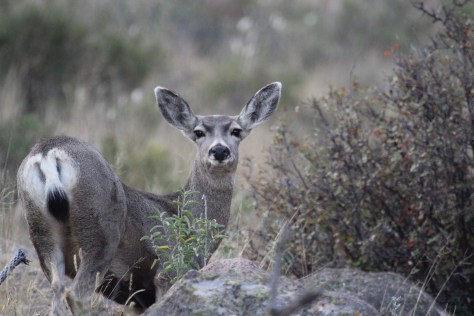
big mule deer doe
A desert mule deer doe showed no fear as we drove up the mountain. Be on the lookout for a special report on Texas mule deer coming soon here at Higher Calling. (Photo by Chester Moore, Jr.)

young mule deer buck
We saw numerous young mule deer bucks on and around the mountain. (Photo by Chester Moore, Jr.)

javelina
This javelina (collared peccary) was super shy but I managed to at least get this photo. These animals are one of the most unique animals in Texas and common in the Trans Pecos. (Photo by Chester Moore, Jr.)

rams on elephant mountain
This was what the trip was all about. I managed to get numerous photos of this herd of bighorns. This herd of one big ram, a bunch of ewes and a few lambs is about half of what the entire Texas population was in 1976. Texas now has around 1,500 bighorns which is a great tribute to the hard work of the Texas Parks & Wildlife Department and groups like the Texas Bighorn Society and The Wild Sheep Foundation. (Photo by Chester Moore, Jr.)

Again, I will have a major magazine feature on Elephant Mountain in the coming months and will post details here. I will also have more from this trip before year’s end.

Subscribe by entering your email address at the top right of this page for comprehensive coverage of mountain wildlife in North America.

Chester Moore

You can subscribe to this blog by entering your email address at the subscribe prompt at the top right of this page. You can contact Chester Moore by emailing chester@chestermoore.com. Subscribe to the podcast by visiting thehighercalling.podbean.com.

The Truth About Color Phase Turkeys (Video)

In March 2019 I began a quest to capture quality photographs of Rio Grande, Merriam’s, Eastern and Osceola turkeys-all within 2019.

The idea is to raise awareness to turkey conservation. I call this project Turkey Revolution!

Hunters (like myself) call this quest the Grand Slam.

And while I took a few hunts this year including bagging my first eastern in New York, this quest is to document with a camera these great birds and to share the experiences through my various media platforms like this blog, Texas Fish & Game, Newstalk AM 560 KLVI and The Wildlife Journalist®.

I happy to announce I wrapped up year one of this adventure in  Colorado photographing Merriam’s turkeys.

I got photos of numerous birds there including a very special one-a cinnamon-colored bearded hen you can see a brief clip of in the video below.


Also check out this photo of another beautiful Merriam’s I found in Colorado and a shot of a  distant flock I got on a return trip in October on a snow-covered mountain.

IMG_3260
The author photographed this Merriam’s turkey in Colorado at an elevation of 7,000 feet. (Photo by Chester Moore, Jr.)

IMG_7417
Merriam’s turkeys bundled up after the first snow in Estes Park, Co. in Oct. 2019. (Photo by Chester Moore, Jr.)

This has been a truly exciting adventure and 2020 looks to be equally as interesting as we are in touch with the top biologists, wildlife managers and hunters around the nation on the issue of turkeys.

You can read the full recap of 2019 at Texas Fish & Game by clicking here.

I hope you get to spend time with your family.

Thank God for the turkey on the table, but most of all those in the woods and on the mountains.

And don’t forget to say a prayer for all of the wild things.

Chester Moore

You can subscribe to this blog by entering your email address at the subscribe prompt at the top right of this page. You can contact Chester Moore by emailing chester@chestermoore.com. Subscribe to the podcast by visiting thehighercalling.podbean.com.

Death Of A Blacktail

The Sacramento River in northern California is magnificent.

With cool waters running from the Klamath Mountains in the shadow of magnificent Mount Shasta it flows over smooth, gray stones along wooded shorelines.

As I made my way up a game trail leading from the main river, a shocking scene unfolded before me.

Lying on the edge of the trail was a massive, dead blacktail buck.

With antlers that would make any hunter proud it was evident this buck had died within the last 24-36 hours.

For a moment I pondered if I might have come across a mountain lion’s kill but it was not buried and there were no marks in the neck. Upon closer examination it was evident coyotes had started eating the hind quarters but there was no sign they killed the buck.

IMG_8377
The author found this magnificent blacktail buck dead along the banks of the Sacramento River. (Photo by Chester Moore, Jr.)

There were also no gunshot wounds. Only a single hole with no exit wound could be found near the base of the neck and judging by the diameter it was made by the antlers of another buck.

It seems like this old buck met his match and I had been fortunate enough to get a glimpse before nature had its way and all of its parts went back into the ecosystem.

The blacktail is America’s forgotten deer.

Whitetail dominate conversations among hunters and wildlife managers and mule deer take up the slack but but blacktail barely make a blip on the radar.

Scientists believe blacktails split off the whitetails eons ago and at some point mule deer arose out of the blacktail.

There are two varieties of blacktail, the Columbia which can be found from California through Washington and the Sitka, which roams British Columbia and Alaska.

Blacktail are facing a number of issues in the Pacific Northwest ranging from an exotic louse introduced to the region in 1995 to loss of habitat and decline of quality forage in available habitat.

A 2018 report by the Mule Deer Working Group of the Western Association of Fish and Wildlife Agencies features concerning observations from a majority of states and provinces in the blacktail’s range.

Oregon: Both mule deer and black-tailed deer are substantially below the long-term statewide management objectives and benchmarks.

Washington: Regional harvest trends indicate black-tailed deer in western Washington have decreased.  Loss of black-tailed deer habitat due to encroaching human development continues to be a concern.

British Columbia: Predation from wolves and cougars on black-tailed deer continues to be a concern in most areas as well as the need for effective measures to conserve high quality habitat. Black-tailed deer buck harvest has dropped by approximately half since the early 1990s.

California’s population seems to be stable but habitat problems proven in other states seem to be rearing its head there. Alaska’s numbers have faced ups and downs but seem to be holding steady overall.

Things are changing quickly in the wilds of the Pacific Northwest and it is my opinion that blacktail and their close cousins the mule deer are the proverbial canaries in the coal mine.

What happens to them is an indicator of what is happening at a much larger level ecologically and I have committed to monitoring this issue.

Finding this massive buck inspired a deeper look at blacktails and gave me an even deeper appreciation for these majestic forest dwellers.

Chester Moore

You can subscribe to this blog by entering your email address at the subscribe prompt at the top right of this page. You can contact Chester Moore by emailing chester@chestermoore.com. Subscribe to the podcast by visiting thehighercalling.podbean.com.

Doubling Down On Mountain Goats

The blessing of have numerous media platforms is the ability to get conservation messages on mountain wildlife out to a diverse group of people.

When a Texas Fish & Game columnist was not able to turn in a column due to an emergency, I used the space to the readership informed on mountain goat conservation and the Rocky Mountain Goat Alliance.

IMG_7863

Mountain goats are truly fascinating creatures who deserve more attention from hunters and those who simply enjoy seeing wildlife.

We will be doing more on mountain goats and other mountain wildlife through a series of expeditions as well as continual communication with the top people at the private, state, tribal and federal level of wildlife management.

Read this article in the Nov. 2019 edition of Texas Fish & Game and don’t forget to check out the podcast with Pete Muennich, founder of the Rocky Mountain Goat Alliance we posted here a couple of weeks ago.

Click here to listen to the podcast.

Chester Moore

You can subscribe to this blog by entering your email address at the subscribe prompt at the top right of this page. You can contact Chester Moore by emailing chester@chestermoore.com. Subscribe to the podcast by visiting thehighercalling.podbean.com.

New Life For New Mexico’s Bighorns

If looks could kill I would have been a dead man.

The ewe fixated on me with a focused intensity.

It was obvious she knew I was a stranger in her rocky domain and I suspected her to bolt at any time.

But as clacking sounded from the rocks below, she broke the stare and looked down.

Up came her baby, a gorgeous Rocky Mountain bighorn born this spring and already masterfully moving up through this gorgeous and treacherous gorge.

lamb running.JPG
Bighorn lambs can weigh as much as 70 pounds during their first winter. This one was climbing up to find its mother. (Photo by Chester Moore, Jr.)

After the lamb came up, eight more bighorns moved up into the plains above the gorge. It was an incredible sight and is proof of New Mexico’s hard work to see its bighorn populations increase.

According to Nicole Tatman, Big Game Program Manager for the New Mexico Department of Game & Fish (Game & Fish), the state has populations of both Rocky Mountain and desert bighorns.

“We actively manage both herds and are always evaluating populations and areas where we can translocate sheep from abundant herds into areas that need more or that currently do not have sheep,” Tatman said.

In 2018, Game & Fish officials released 40 desert bighorns in Alamogordo and over the last decade stockings of Rocky Mountain bighorns in the Rio Grande Gorge and near Bandelier National Monument have proven successful.

The state is able to conduct translocations from its own herd and has seen significant progress in its sheep program. According to Game & Fish officials their desert bighorn herd was an estimated 170 in 2001 and now sits at over 1,000. Rocky Mountain bighorn populations edge that out and are expanding into suitable habitat.

And suitable habitat can change.

The tragic Las Conchas fire that consumed more than 150,000 acres created treeless habitat in the mountains that is perfect for bighorns.

Controlled fire is a practice that benefits sheep along with other wildlife like New Mexico’s Merriam’s turkeys, so it is interesting to see that even after something as catastrophic as that fire, hope can arise.

I plan to do more expeditions into New Mexico in search of bighorns in the next year, focusing both on the desert and Rocky Mountain herds.

ram 1 crop
Chances are this young ram won’t be contributing his genetic this year but he sure showed an interest in this ewe. (Photo by Chester Moore, Jr.

Just before the sheep I found disappeared into their rocky habitat, a young ram tried to make a move on an older ewe. You could tell it wasn’t quite his time yet but the instincts are there.

And those instincts to reproduce, persevere and expand will keep hope alive for New Mexico’s bighorns in the coming years.

Chester Moore

You can subscribe to this blog by entering your email address at the subscribe prompt at the top right of this page. You can contact Chester Moore by emailing chester@chestermoore.com. Subscribe to the podcast by visiting thehighercalling.podbean.com.

Rocky Mountain Goat Alliance (Podcast)

Check out my hour-long interview with Pete Muennich, founder of the Rocky Mountain Goat Alliance, on “Moore Outdoors” on Newstalk AM 560 KLVI.

We discuss the following:

*Mountain Goat Ecology

*The Challenge of Hunting Mountain Goats

*Conservation Of The Species

*Formation of Rocky Mountain Goat Alliance and membership/volunteer opportunities.

You can subscribe to this blog by entering your email address at the subscribe prompt at the top right of this page. You can contact Chester Moore by emailing chester@chestermoore.com. Subscribe to the podcast by visiting thehighercalling.podbean.com.