Tag Archives: Bighorns

Discovering Bighorns

Dubois, WY – The awe-inspiring story of one of North America’s most iconic wildlife species comes to life in Discovering Bighorns, a brand-new documentary by award-winning wildlife vjournalist Chester Moore and cinematographer Paul Fuzinski.

Moore embarked on a mission to uncover an educational platform that not only supports wild sheep conservation but also ignites passion for wildlife in the next generation. His search led him to the National Bighorn Sheep Center in Dubois, WY and the heart of bighorn country, where the Center’s dedication to outreach, education, and conservation takes center stage.

Moore visiting with Vivian, one of the kids in hs program at the National Bighorn Sheep Center.

Through Moore’s Higher Calling Wildlife® initiative—an extension of his Wild Wishes® program, which grants wildlife encounters to children facing special challenges—Discovering Bighorns showcases how real-life experiences in nature can transform lives and cultivate young conservationists. The film captures these emotional and powerful moments, blending stunning visuals and heartfelt storytelling.

“I initially collaborated with them on connecting with families in their area that quality for our Wild Wishes program and soon found the facility not only had great educational value but heart. So, we decided to document this through a mini documentary,” Moore said.

Filmed by Paul Fuzinski and Seth Gieb, and edited by Fuzinski the documentary also features the team’s journey to Yellowstone National Park, highlighting the majestic landscape that supports wild sheep and other mountain ungulates.

Produced, written, and narrated by Chester Moore, Discovering Bighorns not only introduces viewers to the breathtaking world of bighorn sheep, but also delves into the National Bighorn Sheep Center’s national impact—from its interactive exhibits and wildlife tours to its tireless efforts in community outreach and habitat conservation.

Located near the Wind River Mountains, the National Bighorn Sheep Center is a premier destination for wildlife enthusiasts. It offers immersive exhibits, guided tours, and crucial education on the threats facing bighorn sheep—including disease, predation, and human encroachment—while fostering a lifelong appreciation for wildlife and conservation.

“Discovering Bighorns is more than a film. It’s a call to action—a celebration of those who dedicate their lives to conserving these incredible animals and a tribute to the children whose lives are changed by their encounters with them,” Moore said.

The first in a series of public viewings of the film will be at the Hunt-Fish Podcast Summit in Texas March 21 as part of their film festival.

Discovering Bighorns is now available for viewing here. To learn more about the film, the National Bighorn Sheep Center, and how to support bighorn conservation, visit bighorn.org

For interview requests with Chester Moore, email chester@chestermoore.com or text 409-920-2062.

Follow Chester Moore and Higher Calling Wildlife® on the following social media platforms

To support the efforts of Higher Calling Wildlife® click here.

Subscribe to the Dark Outdoors podcast on all major podcasting platforms.

@thechestermoore on Instagram

Chester Moore’s YouTube.

Higher Calling Wildlife on Facebook

Email Chester at chester@chestermoore.com.

National Bighorn Sheep Center Sets The Standard For Conservation Education

Wild sheep are an important part of my life.

Since I was a little boy clipping photos of my favorite game animals out of outdoors magazines and placing them in a scrapbook, these majestic animals have captivated me.

They are also a pillar of our conservation awareness and youth outreach here at Higher Calling Wildlife®.

That’s why I am such a supporter of the National Bighorn Sheep Center in Dubois, WY.

Last year I had the privilege to teach a lesson how to become a conservationist at their annual Camp Bighorn and was bestowed the incredible honor of being named their 2023 “Bighorn Educator of the Year”.

T/hat means I had two occasions to visit the facility and was blown away.

Their mission is to provide education and outreach for the national conservation of wild sheep, wildlife and wild lands and they do an incredible job.

Through their aforementioned Camp Bighorn, educational outreach, ecotours and webinars they reach thousands annually with a pro sheep conservation message.

Partnering with the Wild Sheep Foundation and Wyoming Wild Sheep Foundation, they are in a unique position to teach about these great animals.

The facility itself is beautiful and has museum quality taxidermy displays that are sure to captivate the many young and young at heart in the communiy and that stop by on their way to Grand Teton and Yellowstone.

As a kid I would drive my mom crazy to bring me to a local meat market that had a large taxidermy collection.

Now imagine the impact when such a collection is aimed toward conservation awareness.

This place would have boggled my mind as a kid.

As a man it inspires me and I want to take the time to honor them for their great work and turn you on to their facility, website and outreach.

Check it out. You will not be dissappointed.

National Bighorn Sheep Center.

Chester Moore

Follow Chester Moore and Higher Calling Wildlife® on the following social media platforms

@thechestermoore on Instagram

Chester Moore’s YouTube.

Higher Calling Wildlife on Facebook

Email Chester at chester@chestermoore.com.

Subscribe to the Dark Outdoors and Higher Calling Wildlife podcasts on all major podcasting platforms.

It’s Sheep Show Time!

Greetings from beautiful Reno, NV!

This week I have the privilege of doing content coverage for the Wild Sheep Foundation at their annual Sheep Show.

It’s a public mountain hunting and conservation expo but there are also many wildlife professionals from federal state, provincial and tribal agencies here conducting meetings about putting and keeping wild sheep on the mountain.’

That’s in addition to fundraising and awards banquets, seminars and clinics.

If you’re within driving (or flying) distance of Reno you don’t want to msis it. The expo takes place at the Reno-Sparks Convention Center and kicks off today with events or the whole family.

You can click here to get more info.

“Rocky” the plush bighorn strikes a pose on my laptop. You can follow his adventures on Wild Sheep Foundation social media.

The Wild Sheep Foundation, its chapters and affiliates do incredible work for wild sheep that also benefits many other species throughout North America and Asia. Millions will be raised for wild sheep conservation this week.

You can see my work from the event in future editions of Wild Sheep and Mountain Minutes. I will also have broadcast on the Higher Calling Wildlife and my YouTube channel from the event Friday and Saturday.

Chester Moore

Follow Chester Moore and Higher Calling Wildlife® on the following social media platforms

@thechestermoore on Instagram

Chester Moore’s YouTube.

Higher Calling Wildlife on Facebook

Email Chester at chester@chestermoore.com.

Subscribe to the Dark Outdoors and Higher Calling Wildlife podcasts on all major podcasting platforms.

Honored By National Bighorn Sheep Center

Last Saturday I had the incredible honor of being recognized as “2023 Outstanding Bighorn Teacher” by the National Bighorn Sheep Center in beautiful Dubois, WY. It was for my work teaching kids (and kids at heart) about bighorn sheep and their conservation needs.

For someone who used to cut pictures of bighorns out of Sports Afield, Field and Stream and Outdoor Life and paste them into a scrapbook when he was a little boy this is a huge deal.

But something equally special happened Saturday night. Two little kids who I later found out were son and daughter of the new center director were doing an animal game for kids. As typical for me when I see kids, I went and talked with them about their favorite animals.

They asked me what my favorite American animal was and I said, “bighorn”.

When I got my award I had the chance to speak for a minute and then I walked to the back of the room to shoot a few pics for social media. The little boy I had talked to walked up to me and gave me this little plastic bighorn ram.

“We only had one of these and I saved it for you. Congratulations sir, I figured you might like this.”

This really touched my heart and reinforces what it’s all about-making an impact for kids and wild sheep.

I’m grateful to the National Bighorn Sheep Center for the honor and to Sara Bridge (pictured here with me) for bringing me out to Camp Bighorn this summer to teach the kids about bighorns and conservation.

Chester Moore

Follow Chester Moore and Higher Calling Wildlife® on the following social media platforms

@thechestermoore on Instagram

Higher Calling Wildlife on Facebook

Email Chester at chester@chestermoore.com.

Subscribe to the Dark Outdoors and Higher Calling Wildlife podcasts on all major podcasting platforms.

Social Distancing Can Save Wild Sheep

“Social-distancing” is a term most hope disappears from the lexicon soon. While the concept of keeping a safe distance during the COVID-19 pandemic is wisdom, losing the connection to others is challenging for humanity. For wild sheep, social-distancing is essential.

Domestic sheep and goats can transmit a pathogen that is a setup for pneumonia and other aliments to bighorn and thinhorn sheep that is devastating to herds. It is so devastating that more than two million that existed at the time of Lewis & Clark’s expedition declined to around 25,000 by the early 1900s.

“Wildlife agencies and conservation groups have done a remarkable job of bringing them back to around the 150-175,000 range, but there is still a major problem with exposure to domestic sheep. Die-offs are occurring in pockets right now in states like Oregon and Utah,” said Chester Moore, an award-winning wildlife journalist and founder of Higher Calling Wildlife.

Photo by Chester Moore

Higher Calling Wildlife seeks to raise awareness of mountain and forest wildlife conservation. It also mentors young people dealing with critical illness and traumatic loss to use media for conservation purposes.

One of those young people is Reannah Hollaway, who, through the program and the generosity of the Texas Parks & Wildlife Department, got to take part in a desert bighorn capture and relocation in 2019.

“I have cystic fibrosis, which affects the lungs, and have had to take special precautions during COVID-19. This gives me a unique understanding of the need for keeping wild sheep and domestic sheep apart. This kind of social-distancing can save bighorns,” she said.

Reannah Hollaway helps put a tracking collar on a desert bighorn at Elephant Mountain Wildlife Management Area courtesy of the Texas Parks & Wildlife Department and Higher Calling Wildlife.

Hollaway is a student at Texas Tech and studying to work in the field of wildlife management.

She chose this degree after a wildlife encounter through Higher Calling Wildlife’s mothership, Wild Wishes. This outreach grants wildlife encounters to young people with a critical illness or the loss of a parent or sibling.

To raise awareness of the need for sheep social distancing, Higher Calling WIldlife has begun the Sheep Scrapbook project, which seeks photos taken of wild sheep throughout North America.

Anyone who submits a wild sheep photo to chester@chestermoore.com gets a Sheep Scrapbook Project collector’s coin and a Higher Calling Wildlife decal. Pictures are posted in a gallery at highercallingwildlife.com.

“It’s our way to get people of all backgrounds to think about wild sheep, and the response has been tremendous,” Moore said.

“We’re hoping that when people focus their cameras on sheep, whether in one of our national parks or a hunting or fishing expedition, they can take time to realize these animals are facing a real problem with pneumonia. It’s time all of us who love wild sheep do more to support organizations and agencies searching for ways to keep wild sheep social-distanced from their domestic cousins.”

COVID-19 And The Wild Sheep Decline: An Interesting Parallel

The impact of COVID-19, the coronavirus on humanity, is nothing short of historic.

While the death toll has not and hopefully will not reach the levels of the Spanish flu of 1918, the potential is there, and the grip it has on government, commerce, and private citizens is unprecedented.

That’s why I can’t help but make parallels between COVID-19 and the near-catastrophic decline of wild sheep of the 1800s.

sheep scrapbook 3
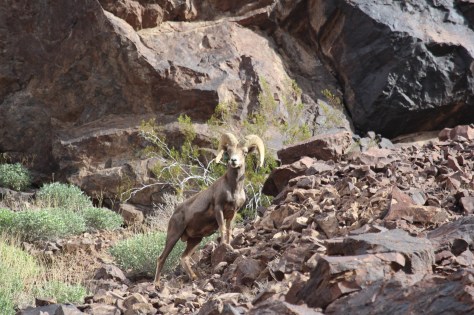
The author photographed this bighorn at 12,000 feet in an area where grazing is restricted but these sheep don’t stay here all the time. Moving into grazing areas is a highly dangerous proposition. (Photo by Chester Moore, Jr.)

When Lewis & Clark set out on their epic expedition, there were around two million wild sheep in North America. By 1900, there were fewer than 25,000 according to some estimates.

And while it would be easy to blame it on unregulated hunting and market killing which no doubt had some impact, by far the biggest killer was disease.

The pathogen M. ovi is common in domestic sheep and quickly spreads through bighorn herds and often ends up in deadly pneumonia

Originating from , it hit wild herds as they co-mingled in the valleys and mountains during the westward expansion of European settlement. Millions of sheep died, and if it were not for conscientious hunters and fish and game departments around the nation, there would likely be no wild sheep left today.

It’s a story few have heard outside of wild sheep hunting and biologist circles, but now is the time.

Flock_of_sheep
Notice the mountains in the background of this sheep lot. Have wild sheep mingled with herds in this area? (Public Domain Photo)

The decline of wild sheep is second only to the government-sponsored bison slaughter in the depth of impact on a species in North America.

Humans are now quarantined, and in effect, bighorns are in many areas.

In 2016, Colorado Parks & Wildlife (CPW) officials killed six bighorns because backpackers saw them co-mingling with domestic sheep. The bacterial form of pneumonia can be brought back to the herd and transmitted to lambs.

“When you have the lambs dying, it’s hard to build a population,” said CPW spokesman Joe Lewandowski in The Durango Herald.

“As wildlife managers, we look at populations, not individual animals. In this case, we know an individual animal could spread the disease to the larger herd, and then we have a bigger problem.”

This is not an uncommon practice in wild sheep management.

While translocations, strict herd management, and grazing restrictions have brought sheep numbers continent-wide into the 150-175,000 range, pneumonia is still the most significant threat. Still, there are no specials on Animal Planet or Nat Geo Wild or any other mainstream media outlets. This pandemic has been going on with wild sheep for 150 years, and only the hunting community, fish and game agencies, and biologists seem to care.

The focus should now be on saving people and the economies of the world, but there is space to teach a valuable lesson on wildlife conservation. There has never been a point in recent history where this particular story of wild sheep has such a great chance to touch the hearts of millions of wildlife enthusiasts.

During the downtime from work and school, people are looking for things to occupy their time and inspired, informative media on some of the beautiful animals in North America can help fill some of that void.

That is what this post is all about. I’m doing my best to let people know that when the dust settles on COVID-19 (and me and my family are praying daily that will happen soon), sheep will still have their own pandemic to face.

Concerned conservationists have done a remarkable job building herds throughout North America, but these conservationists are aging quickly, and new blood needs to step up to the plate.

Maybe something good that can come out of this tragedy is that some young person is motivated to get involved with sheep conservation. Perhaps being isolated, afraid of mingling with others and under the potential threat of death itself because of an unseen force will inspire action.

Sheep, of course, have no way to conceptualize these things, but they don’t need to when caring conservationists are in place in fish and game departments, conservation groups, and halls of the legislature.

COVID-19 may be momentarily stealing our freedoms, but it can’t rob the wild and enduring spirit of those thoughtful enough to make a bold stand for bighorns and their thinhorn cousins.

That force is as majestic as the sheep themselves.

Chester Moore

You can subscribe to this blog by entering your email address at the subscribe prompt at the top right of this page. You can contact Chester Moore by emailing chester@chestermoore.com. Subscribe to the podcast by visiting thehighercalling.podbean.com.

Hidden Bighorn Threat?

When discussing issues impacting bighorn sheep in the United States, three main issues dominate the conversation.

  1. Domestic Sheep Disease Transference
  2. Predation
  3. Habitat Loss/Degradation

And those should be the three primary concerns but there is a growing threat in the Western United States.

Feral hogs.

Hogs polluted all water sources they use to some level. (Public Domain Photo)

Originally brought over by Spanish explorers in the 1500s, feral hogs have taken a foothold in 31 states and there is no question they will eventually move into all of the Lower 48.

According to an article published by the U.S. Department of Agriculture (USDA), feral hogs are a major threat to wildlife through water pollution.

“Water polluted from feral swine wallowing can be contaminated with parasites and bacteria such as giardia, salmonella, and pathogenic E. coli that could be transmitted to humans and other animals. This can happen when feral swine use an agricultural water source, such as an irrigation pond…”

They noted since hogs lack sweat glands, wallowing in mud and water is an instinctual behavior necessary for them to maintain a healthy body temperature.

“Unfortunately this behavior has cascading impacts, not only to water quality in individual streams, ponds, and wetlands, but to entire watersheds and ecosystems.”

Looking at a current distribution map, it is easy to see hogs are already established in the entirety of desert bighorn habitat in Texas and California and are also growing in numbers in New Mexico, Arizona, Colorado and Oregon.

In drought years in particular hogs will impact ponds, stock tanks, streams and guzzlers. These of course are crucial to bighorns and other wildlife.

Feral hogs can also carry pseudorabies.

According to USDA officials, pseudorabies is a disease of swine that can also affect cattle, dogs, cats, sheep, and goats.

“Pseudorabies virus (PRV) is a contagious herpesvirus that causes reproductive problems, (abortion, stillbirths), respiratory problems and occasional deaths in breeding and finishing hogs. Infected newborn pigs may exhibit central nervous system clinical signs.”

It is typically spread through direct contact but there are other ways transmission can occur.

“If present on inanimate objects, such as boots, clothing, feed, trucks, and equipment, the virus can also spread from herd to herd and farm to farm.”

Could hogs transfer PRV to domestic sheep that in turn transfer to bighorns?

Maybe.

And that’s a frightening prospect for animals already facing great challenges.

Desert bighorns in particular could be subject to issues with feral hogs during droughts when all water sources in their range are incredibly valuable. Polluted waterholes could be the source of problem for sheep. (Public Domain Photo)

Another potential threat from hogs is predation.

According to officials with the Texas Parks & Wildlife Department, “wild hogs may prey on fawns, young lambs, and kid goats.”

There is no question hogs could prey on bighorn lambs, especially desert bighorn lambs in the early days of their life. I have found no concrete evidence of hog/wild sheep predation but it remains a possibility.

I will dig more into hog predation on other ungulates in another post but for now just consider what has been presented here.

No one thought 30 years ago feral hogs would now be hunted in New Jersey and more hogs would be killed by hunters in Texas than whitetails.

Could a growing population of hogs in the western United States put more stress on bighorn populations?

I believe it is a possibility, especially the water pollution and disease aspects.

I’ll let you know more as soon as I do.

Chester Moore

You can subscribe to this blog by entering your email address at the subscribe prompt at the top right of this page. You can contact Chester Moore by emailing chester@chestermoore.com. Subscribe to the podcast by visiting thehighercalling.podbean.com.