


For generations, wildlife conservation has centered on a straightforward idea: protect enough animals and enough habitat, and a species has a fighting chance. But what if part of the future of conservation takes place far away from the mountains, forests and grasslands where those animals live? What if some of the most important conservation work involves placing tiny pieces of animals into tanks of liquid nitrogen and keeping them there for decades?
A situation unfolding in New Zealand raises that question. Numbers of Mohaka sheep, a rare feral breed with a long history in the country, have declined to the point that conservationists are moving to preserve their genetics. The effort includes collecting and storing genetic material that could potentially be used in the future.


On the surface, this is a story about an unusual population of sheep. Look deeper, however, and it raises a much larger question: Could preserving cells, semen, eggs, embryos and other biological material become an increasingly important part of protecting rare breeds and endangered wildlife?
Saving Livestock?
Rare livestock breeds and isolated wildlife populations can carry genetic characteristics developed over many generations. Once those animals disappear, some of that genetic diversity can disappear with them.
This doesn’t mean every rare breed possesses some biological secret that will revolutionize agriculture or wildlife conservation. It does mean that once unique genetic material is lost, recovering it may be impossible. Semen and embryo banking are already established tools in livestock management, making the effort involving Mohaka sheep particularly interesting when viewed through the wider lens of conservation.


Saving living populations must remain the objective. Preserving their genetics, however, could provide another option if those populations crash or lose important genetic diversity along the way.
Wildlife conservationists have already been pursuing that idea for half a century.


The Frozen Zoo
Perhaps the greatest example can be found at the San Diego Zoo Wildlife Alliance.
In 1975, researchers established what became known as the Frozen Zoo®. Scientists began preserving living cells from wildlife even though they couldn’t possibly know what technologies might eventually make use of them.
Today the Frozen Zoo is part of the San Diego Zoo Wildlife Alliance’s Wildlife Biodiversity Bank. Its collection contains thousands of living cell lines representing more than 1,300 species and subspecies, with material maintained at approximately minus 320 degrees Fahrenheit. San Diego Zoo Wildlife Alliance Frozen Zoo

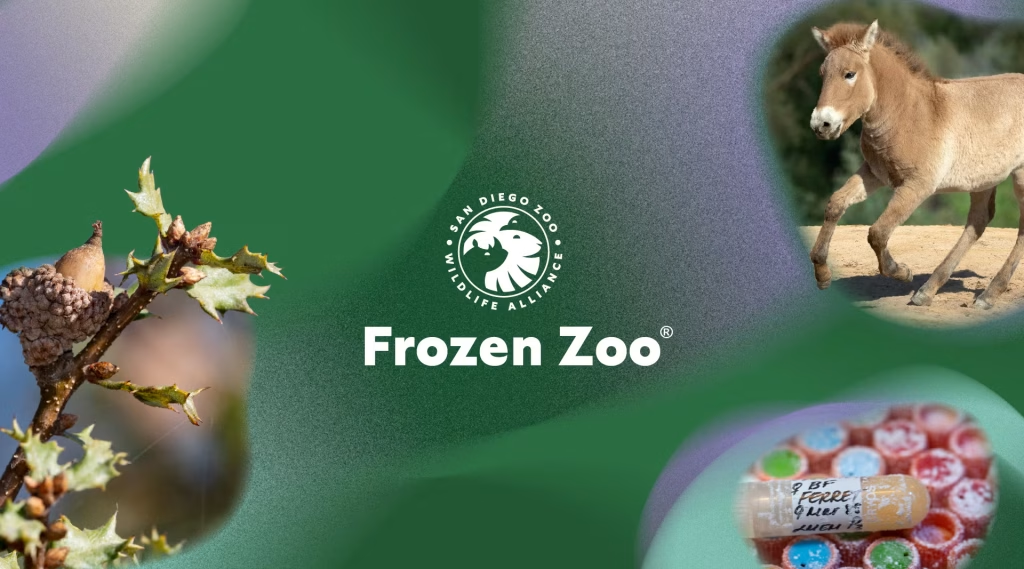
The significance isn’t simply how much material is stored. Some of those cells came from animals that died decades ago. In certain cases, genetic diversity represented by those individuals has subsequently disappeared or become poorly represented within the living population.
The animals are gone. The cells remain.
Scientists in 1975 couldn’t have predicted what conservationists would be capable of doing with those cells 50 years later. Likewise, nobody collecting biological material in 2026 can know what scientists might be capable of doing with it in 2075.
Genetic Insurance
The concept is sometimes described as genetic insurance, and there may be no better way to explain it. Cryopreservation cannot protect habitat, stop poaching, provide water during a drought or prevent a disease outbreak. Those conservation jobs still have to be done.
What it can potentially do is preserve options.
Small populations frequently experience genetic bottlenecks. Even if managers rebuild the number of animals, genetic diversity that disappeared during the decline doesn’t automatically return. Carefully preserved cells and reproductive material could provide future conservationists with opportunities that would otherwise be gone forever.
We already have examples showing that this isn’t purely theoretical.
Frozen Zoo material has contributed to cloning work involving endangered species, including black-footed ferrets and Przewalski’s horses. In those cases, the objective wasn’t simply to create another animal. Scientists were interested in genetics from individuals that were no longer represented, or were poorly represented, in the surviving population.
That changes the conversation considerably. Cryopreservation isn’t only about saving DNA so scientists can study an extinct animal someday. Viable cells, sperm, eggs and embryos may have potential applications that a DNA sequence stored in a computer does not.
What Should We Save Today?
This is where the Mohaka sheep story becomes much bigger than sheep.
By the time an endangered species reaches critically low numbers, a significant amount of its former genetic diversity may already be gone. That raises the question of whether biological banking should begin much earlier.
Wildlife managers routinely capture animals for research, disease testing, translocations and GPS collaring. Zoos, rehabilitation facilities and veterinarians regularly handle threatened and endangered wildlife. Could some of those encounters also become opportunities to preserve biological material for the future?


San Diego Zoo Wildlife Alliance is thinking on an enormous scale. After the Frozen Zoo reached its 50th anniversary, the organization announced an ambitious goal of helping lead efforts to biobank endangered species around the world by 2075. Frozen Zoo 50th anniversary initiative
That doesn’t mean replacing animals on the landscape with samples in a freezer. Habitat protection, population management, disease research, migration corridors, translocations and traditional breeding programs remain essential. Cryopreservation could simply become another tool alongside them—an insurance policy against events and challenges we cannot predict.
And I do think it’s important to note we should not just slack off on boots on the ground conservation. That needs to be priority but this kind of technology needs to be looked at as well.
A Question for the Future
There is something remarkable about looking back at the scientists who began freezing wildlife cells in San Diego in 1975. They had no guarantee those cells would ever become useful, yet they preserved them anyway.
Half a century later, conservationists have technologies that would have been difficult to imagine when some of those samples entered storage. The same may be true of the biological material being preserved today.
That is what makes the declining Mohaka sheep worth watching. Their story raises a question that extends from rare livestock breeds to some of the world’s most endangered wildlife.
Perhaps the greatest value of a frozen cell isn’t what we can do with it today, but what someone may be able to do with it decades from now. When the conservationists of 2075 look back at the species struggling in our time, will they be grateful that we preserved those genetic options for them—or will they wonder why, when we still had the chance, we didn’t?
Chester Moore
Follow Chester Moore and Higher Calling Wildlife® on the following social media platforms
@thechestermoore on Instagram
Higher Calling Wildlife on Facebook
Email Chester at chester@chestermoore.com.
Subscribe to the Dark Outdoors and Higher Calling Wildlife podcasts on all major podcasting platforms.