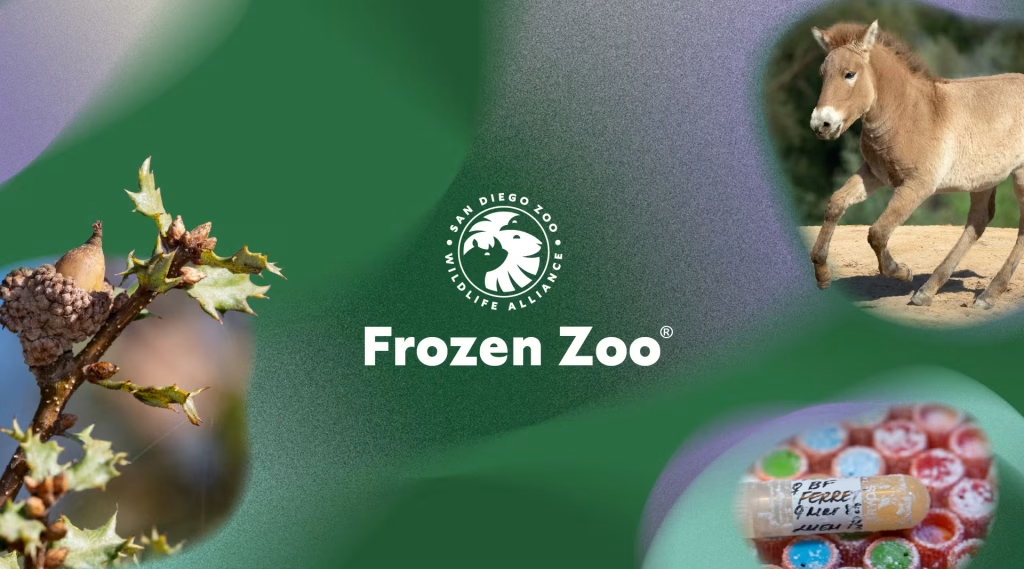
For generations, wildlife conservation has centered on a straightforward idea: protect enough animals and enough habitat, and a species has a fighting chance. But what if part of the future of conservation takes place far away from the mountains, forests and grasslands where those animals live? What if some of the most important conservation work involves placing tiny pieces of animals into tanks of liquid nitrogen and keeping them there for decades?
A situation unfolding in New Zealand raises that question. Numbers of Mohaka sheep, a rare feral breed with a long history in the country, have declined to the point that conservationists are moving to preserve their genetics. The effort includes collecting and storing genetic material that could potentially be used in the future.
On the surface, this is a story about an unusual population of sheep. Look deeper, however, and it raises a much larger question: Could preserving cells, semen, eggs, embryos and other biological material become an increasingly important part of protecting rare breeds and endangered wildlife?
Saving Livestock?
Rare livestock breeds and isolated wildlife populations can carry genetic characteristics developed over many generations. Once those animals disappear, some of that genetic diversity can disappear with them.
This doesn’t mean every rare breed possesses some biological secret that will revolutionize agriculture or wildlife conservation. It does mean that once unique genetic material is lost, recovering it may be impossible. Semen and embryo banking are already established tools in livestock management, making the effort involving Mohaka sheep particularly interesting when viewed through the wider lens of conservation.
Saving living populations must remain the objective. Preserving their genetics, however, could provide another option if those populations crash or lose important genetic diversity along the way.
Wildlife conservationists have already been pursuing that idea for half a century.
The Frozen Zoo
Perhaps the greatest example can be found at the San Diego Zoo Wildlife Alliance.
In 1975, researchers established what became known as the Frozen Zoo®. Scientists began preserving living cells from wildlife even though they couldn’t possibly know what technologies might eventually make use of them.
Today the Frozen Zoo is part of the San Diego Zoo Wildlife Alliance’s Wildlife Biodiversity Bank. Its collection contains thousands of living cell lines representing more than 1,300 species and subspecies, with material maintained at approximately minus 320 degrees Fahrenheit. San Diego Zoo Wildlife Alliance Frozen Zoo
The significance isn’t simply how much material is stored. Some of those cells came from animals that died decades ago. In certain cases, genetic diversity represented by those individuals has subsequently disappeared or become poorly represented within the living population.
The animals are gone. The cells remain.
Scientists in 1975 couldn’t have predicted what conservationists would be capable of doing with those cells 50 years later. Likewise, nobody collecting biological material in 2026 can know what scientists might be capable of doing with it in 2075.
Genetic Insurance
The concept is sometimes described as genetic insurance, and there may be no better way to explain it. Cryopreservation cannot protect habitat, stop poaching, provide water during a drought or prevent a disease outbreak. Those conservation jobs still have to be done.
What it can potentially do is preserve options.
Small populations frequently experience genetic bottlenecks. Even if managers rebuild the number of animals, genetic diversity that disappeared during the decline doesn’t automatically return. Carefully preserved cells and reproductive material could provide future conservationists with opportunities that would otherwise be gone forever.
We already have examples showing that this isn’t purely theoretical.
Frozen Zoo material has contributed to cloning work involving endangered species, including black-footed ferrets and Przewalski’s horses. In those cases, the objective wasn’t simply to create another animal. Scientists were interested in genetics from individuals that were no longer represented, or were poorly represented, in the surviving population.
That changes the conversation considerably. Cryopreservation isn’t only about saving DNA so scientists can study an extinct animal someday. Viable cells, sperm, eggs and embryos may have potential applications that a DNA sequence stored in a computer does not.
What Should We Save Today?
This is where the Mohaka sheep story becomes much bigger than sheep.
By the time an endangered species reaches critically low numbers, a significant amount of its former genetic diversity may already be gone. That raises the question of whether biological banking should begin much earlier.
Wildlife managers routinely capture animals for research, disease testing, translocations and GPS collaring. Zoos, rehabilitation facilities and veterinarians regularly handle threatened and endangered wildlife. Could some of those encounters also become opportunities to preserve biological material for the future?
Photo by Chester Moore
San Diego Zoo Wildlife Alliance is thinking on an enormous scale. After the Frozen Zoo reached its 50th anniversary, the organization announced an ambitious goal of helping lead efforts to biobank endangered species around the world by 2075. Frozen Zoo 50th anniversary initiative
That doesn’t mean replacing animals on the landscape with samples in a freezer. Habitat protection, population management, disease research, migration corridors, translocations and traditional breeding programs remain essential. Cryopreservation could simply become another tool alongside them—an insurance policy against events and challenges we cannot predict.
And I do think it’s important to note we should not just slack off on boots on the ground conservation. That needs to be priority but this kind of technology needs to be looked at as well.
A Question for the Future
There is something remarkable about looking back at the scientists who began freezing wildlife cells in San Diego in 1975. They had no guarantee those cells would ever become useful, yet they preserved them anyway.
Half a century later, conservationists have technologies that would have been difficult to imagine when some of those samples entered storage. The same may be true of the biological material being preserved today.
That is what makes the declining Mohaka sheep worth watching. Their story raises a question that extends from rare livestock breeds to some of the world’s most endangered wildlife.
Perhaps the greatest value of a frozen cell isn’t what we can do with it today, but what someone may be able to do with it decades from now. When the conservationists of 2075 look back at the species struggling in our time, will they be grateful that we preserved those genetic options for them—or will they wonder why, when we still had the chance, we didn’t?
Chester Moore
Follow Chester Moore and Higher Calling Wildlife® on the following social media platforms
Summer 2026 is proving to be an important season for wildlife conservation at the Jerusalem Biblical Zoo.
Nine Persian fallow deer have been released into the wild. Hundreds of tadpoles from one of the world’s rarest amphibians have hatched. Griffon vulture eggs collected from nesting sites across Israel are part of an intensive effort to strengthen the country’s population of these great birds.
And much of this work is now connected through the Shai Doron Nature Conservation Center, which has opened in the zoo’s iconic Noah’s Ark building.
While summer visitors are enjoying camps, animal encounters, behind-the-scenes tours and other activities at the zoo and Gottesman Family Israel Aquarium, an important conservation story is unfolding behind the scenes.
For an institution whose identity has long been connected to the wildlife of the Bible and the Holy Land, summer 2026 is offering fresh evidence that those connections are about more than remembering the past.
The goal is helping wildlife survive into the future.
Nine Deer Return to the Wild
One of the biggest developments this summer involves an animal Higher Calling Wildlife readers have encountered before.
After delays caused by the war, nine Persian fallow deer were successfully released into the Nahal Dolev Nature Reserve.
According to the Jerusalem Biblical Zoo, the release helped increase the estimated wild population in the Judean Hills to approximately 110 animals.
That geographic distinction is important. The figure refers specifically to the Judean Hills population, not the total number of Persian fallow deer living in the wild across Israel.
It’s an encouraging summer update to one of Israel’s most remarkable wildlife restoration stories.
Higher Calling Wildlife recently took readers inside the history and conservation work behind this extraordinary comeback in Restoring Eden’s Deer, our in-depth look at the Jerusalem Biblical Zoo’s Persian fallow deer restoration project.
The nine animals released this year represent the next chapter rather than a retelling of that story.
Each successful release moves the project farther from its beginnings in captive conservation and closer toward its ultimate objective: a thriving wild population.
Seeing Persian fallow deer living once again in the Judean Hills would have been almost unimaginable when the species’ future was hanging by a thread.
Today, the work continues one animal at a time.
A Summer Boost for Griffon Vultures
Another major conservation effort underway in 2026 is taking place at the National Incubation Center for Birds of Prey.
The zoo reports that 28 griffon vulture eggs arrived from nesting sites across Israel, with 16 determined to be fertile. Chicks that hatch will be placed with carefully selected foster pairs by the Israel Nature and Parks Authority as part of the national recovery program.
It is conservation at its most hands-on.
Wildlife restoration is often associated with enormous landscapes, habitat protection and animals being released into wilderness. Sometimes, however, the future of a species can depend upon something as fragile as an egg and the people with the knowledge to give the life inside it its best opportunity to survive.
The Jerusalem Biblical Zoo has been involved in griffon vulture conservation for nearly three decades. Its work includes breeding birds, incubating eggs and helping raise young vultures for eventual release into the wild.
The challenges facing the birds are significant. Poisoning, collisions and electrocution involving power infrastructure, habitat loss and human disturbance have all contributed to their decline.
The summer 2026 eggs are therefore part of a much larger effort to keep these impressive scavengers in Israel’s skies.
300 Reasons for Hope
The smallest animals involved in the zoo’s summer conservation news might represent the most extraordinary development of all.
Approximately 300 Hula painted frog tadpoles have hatched at the zoo’s conservation breeding center after months of research and breeding efforts.
That number becomes even more impressive when you consider the history of the Hula painted frog.
The species was last observed in the wild in 1955 and was officially declared extinct by the International Union for Conservation of Nature in 1996. Then, in November 2011, a Hula painted frog was discovered in the Hula Valley.
A species the world believed it had lost was alive.
But rediscovering an animal and securing its future are two very different things.
The frog remains critically endangered and survives in only a handful of wetlands and waterways in the Hula Valley. The Jerusalem Biblical Zoo, working closely with the Israel Nature and Parks Authority, established an ex situ conservation program designed to create a backup population and increase scientific understanding of the animal.
Now summer 2026 brings an encouraging development in that effort.
Hundreds of tadpoles are alive at the conservation breeding center.
For an animal that disappeared from scientific observation for more than half a century, successful reproduction on this scale represents an important step.
Rediscovering an animal believed extinct is extraordinary.
Helping make sure it doesn’t disappear again is the harder task.
This summer, there are approximately 300 tiny reasons for hope.
New Life at the Zoo and Aquarium
Summer 2026 has brought other notable births and reproductive milestones as well.
The Jerusalem Biblical Zoo celebrated the birth of its first Bornean orangutan baby. Thirteen-year-old Suga and 19-year-old Ito welcomed a male named Chahaya, a name meaning “halo” or “light” in Indonesian.
Bornean orangutans are critically endangered, making the birth important beyond its obvious appeal to zoo visitors.
The Jerusalem Zoo’s orangutans participate in the European Association of Zoos and Aquaria breeding program, which carefully manages breeding according to factors including genetics and age to help maintain a healthy and genetically diverse population.
According to the zoo, only one Bornean orangutan infant was born in European zoos last year, adding significance to Chahaya’s arrival.
There has been significant news underwater as well.
At the Gottesman Family Israel Aquarium, golden dogfish sharks laid eggs in the Mediterranean Sea exhibit for the first time in the aquarium’s history.
Often called “mermaid’s purses,” the egg cases are attached to a rope within the exhibit where visitors can observe them.
For families visiting this summer, that creates an unusual opportunity to see a part of the shark life cycle most people will never encounter in the wild.
A Summer of Restoration
There is something especially fitting about this work taking place at the Jerusalem Biblical Zoo, an institution whose conservation mission includes restoring endangered native wildlife—including species that had disappeared from Israel—to the country’s natural landscapes.
But summer 2026 is about much more than looking backward.
The Persian fallow deer released into the Nahal Dolev Nature Reserve are part of a living restoration story unfolding in the Judean Hills. The griffon vulture work represents an effort to keep one of the region’s great birds soaring overhead. And perhaps most remarkably, hundreds of Hula painted frog tadpoles offer new hope for a species once believed to have vanished forever.
Those are significant victories, but conservation is rarely finished with a single release, successful hatch or breeding season. Each represents another step in work that can stretch across decades.
That makes the opening of the Shai Doron Nature Conservation Center in the zoo’s iconic Noah’s Ark building particularly appropriate.
The biblical ark represents preservation in the face of tremendous loss. The conservation work underway in Jerusalem during the summer of 2026 carries a modern echo of that idea—protecting wildlife while there is still time and, whenever possible, returning animals to the wild landscapes where they belong.
This summer, those efforts can be measured in very different ways: nine deer stepping back into the wild, developing vulture eggs carrying the possibility of future birds in Israel’s skies, and hundreds of tiny tadpoles from a species once written off as extinct.
For the Persian fallow deer roaming the Judean Hills and the Hula painted frogs beginning a new generation in Jerusalem, restoration is no longer just an aspiration.
It is happening now
Chester Moore
Follow Chester Moore and Higher Calling Wildlife® on the following social media platforms
Inside the Jerusalem Biblical Zoo’s Persian Fallow Deer Restoration Project
By Chester Moore
For the Persian fallow deer, survival has never come easily.
Once common across parts of the ancient Middle East, this remarkable animal disappeared from Israel centuries ago and was eventually believed lost forever. Its rediscovery in Iran during the 1950s transformed what many thought was a story of extinction into one of hope. Since then, generations of conservationists have worked patiently to restore the species to the landscapes where it once belonged.
That work continues today.
Photo courtesy Jerusalem Biblical Zoo.
Earlier this year, wildlife biologists prepared another carefully planned a release designed to strengthen Israel’s growing wild population of Persian fallow deer. The animals were healthy. Their release sites had been selected. Spring had arrived, bringing the lush vegetation that gives newly released deer their greatest opportunity to adapt to life in the wild.
Then the mission was delayed.
Military conflict disrupted GPS signals used to track the deer after their release, making it impossible for conservationists to reliably monitor the animals through their satellite collars. Rather than risk decades of painstaking conservation work, the team postponed the release until those systems could once again provide the information needed to safeguard the animals.
It was a powerful reminder that wildlife conservation does not happen apart from the rest of the world. Even the most carefully planned restoration efforts can be affected by events far beyond the control of the scientists, veterinarians and field biologists dedicated to protecting them.
Yet if the history of the Persian fallow deer teaches us anything, it is this: perseverance has always been the foundation of its remarkable comeback.
A Living Link to Biblical History
The Persian fallow deer is more than an endangered species. It represents a living connection to the biblical landscape and one of conservation’s most remarkable restoration stories.
“The beginning of this project is actually in the Bible,” said Dr. Shai Ben-Ami, Director of Development for the Jerusalem Biblical Zoo. “
The Persian fallow deer was mentioned in the Bible as one of the pure animals.
Collared Persian fallow deer being released. (Photo courtesy Jerusalem Biblical Zoo)
That Biblical significance became one of the driving forces behind saving the species after a small population was rediscovered in Iran in 1955.
“This is one of the reasons why zoos and wildlife authorities really wanted to have this specific species,” Ben-Ami said.
“It was thought to be extinct until they discovered a small group in Iran in 1955.”
Instead of becoming another tragic chapter in extinction history, the Persian fallow deer suddenly represented something extraordinary—a second chance.
A Gift Worth More Than Cadillacs
Like many remarkable wildlife stories, the restoration of the Persian fallow deer almost sounds too unbelievable to be true.
Ben-Ami shared the remarkable story of how the project began.
The brother of the Shah of Iran visited Israel to hunt ibex. Grateful for the experience, he offered expensive gifts in return.
“They asked… he offered Cadillacs. He offered cars,” Ben-Ami said.
“They said, ‘We don’t need that. We really need a few Persian fallow deer from your group.'”
His answer was simple.
“‘You helped me. Let me help you.'”
That extraordinary gesture made it possible to begin building a breeding population, but events soon threatened to end the effort before it had truly begun.
A large Persian fallow deer buck. (Photo by Chester Moore)
As Iran moved toward the 1979 Iranian Revolution, conservationists realized the window to move the deer out of the country was rapidly closing. Four female Persian fallow deer were transported from the reserve where they had been protected toward Tehran. During the journey, several were found to be pregnant, providing an unexpected boost to the tiny founder population. Those females were later joined by two males from Germany, creating the nucleus of the breeding program that ultimately made the species’ return to Israel possible.
Looking back today, it is astonishing to realize how much depended on those six animals.
Entire wildlife restoration programs are often are remembered for the thousands of animals that eventually roam the landscape. What we sometimes forget is that many begin with only a handful of founders—and the determination of people who recognize that an opportunity to save a species may never come again.
Bringing a Biblical Species Home
The first releases into the wild began during the late 1980s. When the Jerusalem Biblical Zoo relocated to its current site, it embraced the project as one of its defining conservation missions.
In fact, the Persian fallow deer became so important to the institution that it replaced the lion as the zoo’s official logo—a symbol that restoring native wildlife had become central to the zoo’s identity.
The work was anything but simple.
Animals were released into suitable habitat in Israel’s Judean Hills, but wildlife managers soon encountered unexpected obstacles. Packs of free-ranging dogs entered protected areas and preyed upon some of the deer before the problem could be addressed. Like virtually every restoration project around the world, setbacks became part of the journey rather than the end of it.
Today, between 150 and 200 Persian fallow deer live in the wild in Israel, and additional releases are based not on arbitrary numbers but on science.
Fawns born in the wild are a sign of success. (Photo courtesy Jerusalem Biblical Zoo)
“We decide to release according to what is the need in the wild,” Ben-Ami explained. Researchers monitor births, survival and population trends before determining how many animals should be released each year.
That philosophy mirrors successful restoration projects throughout North America.
Desert bighorn sheep restoration in Texas has required decades of careful planning, habitat management and ongoing monitoring. American bison restoration has followed a similarly patient path. Wildlife conservation isn’t measured by the excitement of release day. It is measured years later, when animals born in the wild raise offspring of their own.
Desert bighorn released into Franklin Mountains of West Texas in 2024. (Photo by Chester Moore)
The Persian fallow deer has reached that point.
And yet another challenge remains largely invisible to the public.
“When you have such a small population, that’s a big problem,” Ben-Ami said of genetics. “We monitor the breeding… we send it to laboratories… and we work with the European zoo association… to make sure the genetics will be fine.”
For Ben-Ami and his colleagues, conservation does not end when an animal is released. It continues through careful genetic management, cooperation among zoological institutions and constant scientific evaluation to ensure the population remains healthy for generations to come.
Restoring What Was Lost
The Persian fallow deer may be the Jerusalem Biblical Zoo’s best-known conservation success, but it represents something much larger than the recovery of a single species. It reflects a philosophy that has shaped the institution for decades—one centered not simply on exhibiting wildlife, but on restoring it.
Around the world, many zoological institutions support conservation through grants, research partnerships and field projects. Those contributions are invaluable. Yet Ben-Ami believes the Jerusalem Biblical Zoo has carved out a unique role by becoming directly involved in bringing species back to the wild.
“We looked it up,” he said.
“We have more than five or six different projects of reintroduction, which is very unique even in the zoo world.”
The success of the Persian fallow deer restoration reflects a conservation philosophy that now reaches from mammals to birds and even amphibians, with each project sharing the same ultimate goal of returning native wildlife to the landscapes where it belongs.
One of the zoo’s most remarkable projects centers on a small amphibian few people outside Israel have ever heard of—the Hula painted frog.
For decades, the species was believed extinct.
Ben-Ami remembers leading visitors through the zoo years ago and explaining that the frog had disappeared forever.
“I used to sit down and tell people, ‘Oh, you know this frog… it got extinct already in the ’50s. So basically we lost this species.'”
Then, in 2011, everything changed.
“One day they discovered it,” he said.
“That was a huge day. It’s like they would discover brown bears in California all of a sudden after years that they were away.”
When conflict threatened the Hula Valley, a group of approximately 20 frogs was relocated to the Jerusalem Biblical Zoo for safekeeping. The challenge facing zoo staff went far beyond simply caring for them. Because the species had effectively disappeared for decades, researchers knew remarkably little about its biology.
“We didn’t know anything about this animal. We didn’t know how big it should be. We didn’t know when they can start breeding. We didn’t know what they prefer to eat.”
The uncertainty only made the achievement more significant.
“We actually managed to breed them,” he said.
“We were the first in the world to breed this animal, and we are going to release them back into the wild.”
The same restoration philosophy extends into the skies above Israel.
Griffon vultures, among the region’s most important scavengers, continue to face enormous challenges from poisoning and illegal shooting in parts of the Middle East. To strengthen the population, the zoo has partnered with wildlife authorities to receive birds from Spain and other countries, conduct health evaluations behind the scenes and prepare them for release into the wild.
The zoo has also worked to restore Eurasian otters, another species whose numbers have declined dramatically as wetlands disappeared and waterways changed. Although that project has encountered challenges, it reflects the same long-term commitment that defines every restoration effort—careful planning, scientific collaboration and the patience to continue even when success does not come quickly.
Taken together, these projects reveal an institution that views conservation not as a single achievement but as an ongoing responsibility.
Looking Beyond Today’s Successes
Even after decades of conservation victories, Ben-Ami is already looking toward what comes next.
Among his greatest hopes is expanding regional cooperation to restore species whose historic ranges extend far beyond modern political boundaries.
“My dream is the Arabian leopard,” he said.
“My goal… is to help have some kind of connection to help this very unique animal.”
Ben-Ami believes recent regional cooperation, including the opportunities created by the Abraham Accords, could eventually allow conservationists to work more closely across borders to protect and restore species that have always ignored political boundaries. That vision, he believes, is larger than any single institution or nation—it is about preserving a shared natural heritage for future generations.
Most people are not aware that there is a leopard species indigenous to the Middle East. (Public Domain Photo)
“This is the vision of a new Middle East,” Ben-Ami said.
“That’s how it should look—helping each other to bring animals back into the wild.”
Whether that vision becomes reality remains to be seen.
What cannot be questioned is what has already been accomplished.
A species once believed extinct now once again walks the hills of Israel.
An amphibian thought lost to history has been bred for the first time and is returning to its native wetlands.
Griffon vultures continue to soar because dedicated conservationists refused to give up.
Each project stands on its own, but together they tell a larger story—not simply about saving wildlife, but about restoring pieces of a natural world that many assumed were gone forever.
The Long Road Back
Earlier this year, the Persian fallow deer had to wait.
The delay was frustrating, but it also underscored an important truth. Wildlife restoration is rarely a straight path. It is shaped by unexpected obstacles, changing conditions and decisions that place long-term success ahead of short-term progress.
That lesson extends far beyond Israel.
Every successful conservation project from red wolves released in North Carolina to wood ducks restored along the Eastern seaboard has demanded extraordinary patience. The Persian fallow deer belongs among those great conservation stories, not simply because a species survived, but because generations of people refused to let its story end.
Red wolf. (Photo by Chester Moore)
The Jerusalem Biblical Zoo has become one of the world’s leading examples of that commitment.
Its work demonstrates that conservation is about more than protecting what remains. At its best, it is about restoring what has been lost and ensuring future generations inherit landscapes that are richer, healthier and more complete than the ones we found.
For the Persian fallow deer, that journey continues with every new fawn born in the wild, every carefully planned release and every scientist, veterinarian and wildlife professional who believes restoration is worth the effort.
A Persian fallow deer in the wild in Israel. (Photo courtesy Jerusalem Biblical Zoo)
The Persian fallow deer is no longer simply a survivor remembered in history or Scripture. It is once again part of Israel’s living landscape, raising young in the wild and reclaiming habitat where it disappeared centuries ago. That alone makes it one of the great wildlife restoration stories of our time.
For Dr. Ben-Ami and the team at the Jerusalem Biblical Zoo, however, the story has never been just about one deer. It is about believing that what has been lost is not always lost forever. Whether restoring griffon vultures to the skies, breeding a frog once believed extinct or returning Persian fallow deer to the forests, each project begins with the same conviction that careful stewardship, perseverance and hope can change the future.
Perhaps that’s why this story resonates far beyond the boundaries of a wildlife reserve or a zoological park. Throughout Scripture, we encounter a Creator who delights in life, who entrusts humanity with the care of creation and who specializes in restoration. The work taking place at the Jerusalem Biblical Zoo offers a glimpse of that calling lived out in a tangible way through decades of patient, faithful work. One animal. One release. One generation at a time.
Today, the Persian fallow deer once again walks the hills of the Holy Land.
A small, dark amphibian sits half-hidden among reeds inside the amphibian exhibit at the Jerusalem Biblical Zoo. At first glance, it does not stand out.
Yet this is the Hula painted frog (Latonia nigriventer), a species once declared extinct and now the focus of one of the zoo’s most important conservation programs.
The frog was first described in 1940 near Lake Hula and last observed in 1955. After decades without sightings, it was officially declared extinct in 1996 — the first amphibian in the nation ever listed that way.
Then, in 2011, a single individual was rediscovered in the Hula Valley following years of wetland restoration.
Subsequent genetic and morphological research revealed that the species belongs to an ancient lineage once believed to have disappeared at the end of the last Ice Age.
Today, it survives in only a small number of wetlands, and the total wild population is estimated at just a few hundred individuals.
It is classified as Critically Endangered.
In response to its rediscovery, the Jerusalem Zoo partnered with the Israel Nature and Parks Authority to establish a formal research and conservation initiative.
As stated in the official document:
“Building on a long-standing collaboration with the Israel Nature and Parks Authority and a proven track record in conservation initiatives, the Jerusalem Zoo was granted permission to initiate an ex situ research and conservation program for Latonia nigriventer.” The comeback of the Hula Painte…
A founding group of frogs was transferred to the zoo. Two dedicated facilities were created: a behind-the-scenes unit for egg incubation and larval rearing, and a public exhibit designed to raise awareness while respecting the frog’s secretive nature.
The program focuses on gathering essential biological information:
“The primary goal is to uncover key aspects of the species’ biology through controlled husbandry and monitoring, thereby providing essential data to support both ex situ breeding and in situ habitat protection.” The comeback of the Hula Painte…
Because the species had been absent for decades, basic details about its breeding cycle, development, and dietary needs were largely unknown. Research conducted at the zoo helps fill these gaps and supports habitat protection efforts in the Hula Valley.
Established in 1993 as a non-profit institution through a partnership between the Jerusalem Municipality, the Jerusalem Foundation, the Jerusalem Development Authority, and the Ministry of Tourism, the zoo was built as both a public space and a conservation center. The Hula painted frog program reflects that mission directly.
Visitors who enter the amphibian exhibit may not immediately recognize the importance of the small frog they see. The display is modest. Behind the scenes, however, ongoing research continues — steady, careful, and long-term.
The Jerusalem Zoo is currently the only zoo in the world to house this species and present its conservation story.
In a quiet corner of the zoo, work is underway to ensure that this time, the frog’s story does not end.
The Biblical Zoo in Jerusalem has successfully reintroduced 20 Persian (Mesopotamian) fallow deer into the wild this spring. The release marks a bold new chapter for the species, once teetering on the brink of extinction.
“We’re beyond excited to share that our Spring 2025 Persian (Mesopotamian) fallow deer release has successfully reintroduced 20 captive-bred deer into the wild!” the zoo announced.
This release took place at Nachal Dolev Nature Reserve, nestled in the scenic Judean Hills, just 25 kilometers from Jerusalem.
The location is significant. For two decades, the zoo has been working tirelessly to restore the Persian fallow deer population through carefully managed releases. Now, for the first time, the deer are being returned to new territory closer to Jerusalem, allowing them to reclaim portions of their ancient habitat.
“After 20 years of successful reintroductions, we’re now expanding to new territory near Jerusalem, helping this once nearly extinct species reclaim its ancient homeland!” the zoo shared.
The latest release also marked a major shift in strategy. In past efforts, the deer were gradually introduced to the wild using fenced acclimatization areas, allowing them time to adjust to their new surroundings. This time, however, the zoo’s team took a more daring approach.
“For the first time, we released the deer directly into the wild—without a fenced acclimatization area!” they said.
Extensive research conducted over the years had shown that the fallow deer are remarkably adaptable and capable of thriving in the Judean Hills, where food sources and water are plentiful.
To ensure the safety and success of the reintroduction, each deer has been fitted with an electronic tracking collar.
These devices enable the zoo’s scientists to monitor the animals’ movements and behaviors in real time, providing critical data on how the deer adjust to their new environment. The information gathered will help guide future conservation efforts, both in Israel and abroad.
Beyond the scientific achievement, the release was also a day of celebration.
“The day itself was a celebration—a joyful outing in the stunning spring landscape, surrounded by wildflowers and perfect weather,” the zoo reported.
Staff, scientists, and volunteers gathered to witness the culmination of years of hard work and dedication. “It was a well-earned reward for our dedicated staff and volunteers, whose tireless efforts are bringing this majestic species back to life.”
The success of the Persian fallow deer restoration project is a poweful conservation statement in a war-torn part of the world.
Thanks to the Biblical Zoo and its partners, these graceful creatures now roam once again where their ancestors once thrived—a living symbol of renewal in the land of their origin.
UPDATE: We got a report from our friends at the Jerusalem Biblical Zoo that skies are clear in the area.
“Reports are that the deer are okay. They have an area which is not burnt and has food,” said the zoo’s Rachael Risby Raz.
You can read our initial report on the fire situation below and learn more about the struggles with wildlife in Israel and how you can support the Persian fallow deer project.
Here’s a photo from this morning from the Israel Nature and Parks Authority showing one of the fallow deer bucks post-fire.
(Photo Israel Nature and Parks Authority)
Israel—A major wildfire is burning in the Jerusalem Hills area.
An older female with a GPS collar (an earlier release from the Zoo’s breeding core) together with fawn who was born this year; another female whose neck we cannot see in the picture, so it is not possible to determine whether she was released from the Zoo or is a nature-born deer; and the fourth deer is a young nature-born deer. (Photo Israel Nature and Parks Authority.)
An article in The Jerusalem Post quoted Fire Chief Insp.-Gen. Dedi Simchithe saying the blaze was human-caused, although it was still unclear if it was an accident, due to negligence or intentionally sparked.
Other sources point directly to arson, which makes this even more tragic.
“The thick smoke from the fire was seen from Jerusalem as the skies darkened over the city,” said Rachael Risby Raz with the Jerusalem Biblical Zoo.
Zoo officials saw the smoke overhead and ashes fell at the zoo, which is around 15 kilometers away from where the center of the blaze was.
Today’s smoke-impacted view from the Jerusalem Biblical Zoo.
“Our thoughts went immediately to our Persian fallow deer, who are part of the Zoo’s successful re-introduction project in the Jerusalem Hills. The acclimatization enclosure for the project and the main area where the deer live is in the area of Nahal Sorek,” Raz said.
The Zoo conservation team were in touch with the Israel Nature and Parks Authority, who are their partners in this important endeavor, throughout the day and night.
“Luckily the fire did not go down from the direction of Har HaTayassim to the Nahal Sorek gorge. This is good news for our deer, they had a place to go. The vast majority of the area in which they are concentrated has not been damaged,” Raz said.
We will keep you updated as we believe this is one of the planet’s most important conservation projects.
This year zoo officials reported the breeding herd there had 13 fawns and there have been several generations of deer born in the wild.
Restoring this deer of the Garden of Eden to the Holy Land is a worthy project and one we recommend you support if possible.
Our prayers are with Jerusalem, Israel, the Jerusalem Biblical Zoo and their conservation projects.
Yesterday we announced that we created our own conservation outreach Higher Calling Wildlife. Everyone who joins for FREE gets this very special edition Higher Calling Wildlife “Wildlife Of Israel” e-mag.
It’s the first of its kind magazine focusing solely on Israel’s wildlife and we chose to debut it today as the Jewish festival of Rosh Hashanah (Feast of Trumpets) begins this evening.
This is the New Year on the calendar God gave to the Hebrews and since supporting Israel’s wildlife is one of our pillars, we thought this would be a good way to celebrate and also a new beginning for us.
You can subscribe to this blog by entering your email address at the subscribe prompt at the top right of this page. You can contact Chester Moore by emailing chester@chestermoore.com. Subscribe to the podcast by visiting thehighercalling.podbean.com.