In March 2019 I began a quest to capture quality photographs of Rio Grande, Merriam’s, Eastern and Osceola turkeys-all within 2019.
The idea is to raise awareness to turkey conservation. I call this project Turkey Revolution!
Hunters (like myself) call this quest the Grand Slam.
And while I took a few hunts this year including bagging my first eastern in New York, this quest is to document with a camera these great birds and to share the experiences through my various media platforms like this blog, Texas Fish & Game, Newstalk AM 560 KLVI and The Wildlife Journalist®.
I happy to announce I wrapped up year one of this adventure in Colorado photographing Merriam’s turkeys.
I got photos of numerous birds there including a very special one-a cinnamon-colored bearded hen you can see a brief clip of in the video below.
Also check out this photo of another beautiful Merriam’s I found in Colorado and a shot of a distant flock I got on a return trip in October on a snow-covered mountain.
The author photographed this Merriam’s turkey in Colorado at an elevation of 7,000 feet. (Photo by Chester Moore, Jr.)Merriam’s turkeys bundled up after the first snow in Estes Park, Co. in Oct. 2019. (Photo by Chester Moore, Jr.)
This has been a truly exciting adventure and 2020 looks to be equally as interesting as we are in touch with the top biologists, wildlife managers and hunters around the nation on the issue of turkeys.
Thank God for the turkey on the table, but most of all those in the woods and on the mountains.
And don’t forget to say a prayer for all of the wild things.
Chester Moore
You can subscribe to this blog by entering your email address at the subscribe prompt at the top right of this page. You can contact Chester Moore by emailing chester@chestermoore.com. Subscribe to the podcast by visiting thehighercalling.podbean.com.
The Sacramento River in northern California is magnificent.
With cool waters running from the Klamath Mountains in the shadow of magnificent Mount Shasta it flows over smooth, gray stones along wooded shorelines.
As I made my way up a game trail leading from the main river, a shocking scene unfolded before me.
Lying on the edge of the trail was a massive, dead blacktail buck.
With antlers that would make any hunter proud it was evident this buck had died within the last 24-36 hours.
For a moment I pondered if I might have come across a mountain lion’s kill but it was not buried and there were no marks in the neck. Upon closer examination it was evident coyotes had started eating the hind quarters but there was no sign they killed the buck.
The author found this magnificent blacktail buck dead along the banks of the Sacramento River. (Photo by Chester Moore, Jr.)
There were also no gunshot wounds. Only a single hole with no exit wound could be found near the base of the neck and judging by the diameter it was made by the antlers of another buck.
It seems like this old buck met his match and I had been fortunate enough to get a glimpse before nature had its way and all of its parts went back into the ecosystem.
The blacktail is America’s forgotten deer.
Whitetail dominate conversations among hunters and wildlife managers and mule deer take up the slack but but blacktail barely make a blip on the radar.
Scientists believe blacktails split off the whitetails eons ago and at some point mule deer arose out of the blacktail.
There are two varieties of blacktail, the Columbia which can be found from California through Washington and the Sitka, which roams British Columbia and Alaska.
Blacktail are facing a number of issues in the Pacific Northwest ranging from an exotic louse introduced to the region in 1995 to loss of habitat and decline of quality forage in available habitat.
A 2018 report by the Mule Deer Working Group of the Western Association of Fish and Wildlife Agencies features concerning observations from a majority of states and provinces in the blacktail’s range.
Oregon: Both mule deer and black-tailed deer are substantially below the long-term statewide management objectives and benchmarks.
Washington: Regional harvest trends indicate black-tailed deer in western Washington have decreased. Loss of black-tailed deer habitat due to encroaching human development continues to be a concern.
British Columbia: Predation from wolves and cougars on black-tailed deer continues to be a concern in most areas as well as the need for effective measures to conserve high quality habitat. Black-tailed deer buck harvest has dropped by approximately half since the early 1990s.
California’s population seems to be stable but habitat problems proven in other states seem to be rearing its head there. Alaska’s numbers have faced ups and downs but seem to be holding steady overall.
Things are changing quickly in the wilds of the Pacific Northwest and it is my opinion that blacktail and their close cousins the mule deer are the proverbial canaries in the coal mine.
What happens to them is an indicator of what is happening at a much larger level ecologically and I have committed to monitoring this issue.
Finding this massive buck inspired a deeper look at blacktails and gave me an even deeper appreciation for these majestic forest dwellers.
Chester Moore
You can subscribe to this blog by entering your email address at the subscribe prompt at the top right of this page. You can contact Chester Moore by emailing chester@chestermoore.com. Subscribe to the podcast by visiting thehighercalling.podbean.com.
It was obvious she knew I was a stranger in her rocky domain and I suspected her to bolt at any time.
But as clacking sounded from the rocks below, she broke the stare and looked down.
Up came her baby, a gorgeous Rocky Mountain bighorn born this spring and already masterfully moving up through this gorgeous and treacherous gorge.
Bighorn lambs can weigh as much as 70 pounds during their first winter. This one was climbing up to find its mother. (Photo by Chester Moore, Jr.)
After the lamb came up, eight more bighorns moved up into the plains above the gorge. It was an incredible sight and is proof of New Mexico’s hard work to see its bighorn populations increase.
According to Nicole Tatman, Big Game Program Manager for the New Mexico Department of Game & Fish (Game & Fish), the state has populations of both Rocky Mountain and desert bighorns.
“We actively manage both herds and are always evaluating populations and areas where we can translocate sheep from abundant herds into areas that need more or that currently do not have sheep,” Tatman said.
In 2018, Game & Fish officials released 40 desert bighorns in Alamogordo and over the last decade stockings of Rocky Mountain bighorns in the Rio Grande Gorge and near Bandelier National Monument have proven successful.
The state is able to conduct translocations from its own herd and has seen significant progress in its sheep program. According to Game & Fish officials their desert bighorn herd was an estimated 170 in 2001 and now sits at over 1,000. Rocky Mountain bighorn populations edge that out and are expanding into suitable habitat.
And suitable habitat can change.
The tragic Las Conchas fire that consumed more than 150,000 acres created treeless habitat in the mountains that is perfect for bighorns.
Controlled fire is a practice that benefits sheep along with other wildlife like New Mexico’s Merriam’s turkeys, so it is interesting to see that even after something as catastrophic as that fire, hope can arise.
I plan to do more expeditions into New Mexico in search of bighorns in the next year, focusing both on the desert and Rocky Mountain herds.
Chances are this young ram won’t be contributing his genetic this year but he sure showed an interest in this ewe. (Photo by Chester Moore, Jr.
Just before the sheep I found disappeared into their rocky habitat, a young ram tried to make a move on an older ewe. You could tell it wasn’t quite his time yet but the instincts are there.
And those instincts to reproduce, persevere and expand will keep hope alive for New Mexico’s bighorns in the coming years.
Chester Moore
You can subscribe to this blog by entering your email address at the subscribe prompt at the top right of this page. You can contact Chester Moore by emailing chester@chestermoore.com. Subscribe to the podcast by visiting thehighercalling.podbean.com.
Check out my hour-long interview with Pete Muennich, founder of the Rocky Mountain Goat Alliance, on “Moore Outdoors” on Newstalk AM 560 KLVI.
We discuss the following:
*Mountain Goat Ecology
*The Challenge of Hunting Mountain Goats
*Conservation Of The Species
*Formation of Rocky Mountain Goat Alliance and membership/volunteer opportunities.
You can subscribe to this blog by entering your email address at the subscribe prompt at the top right of this page. You can contact Chester Moore by emailing chester@chestermoore.com. Subscribe to the podcast by visiting thehighercalling.podbean.com.
There’s something about being in the mountains that cleanses the soul.
No matter what kind of baggage we bring from our day to day lives, being in the mountains brings peace.
And on the flip-side, encountering wildlife in the mountains can be the most exhiirating thing a person can experience.
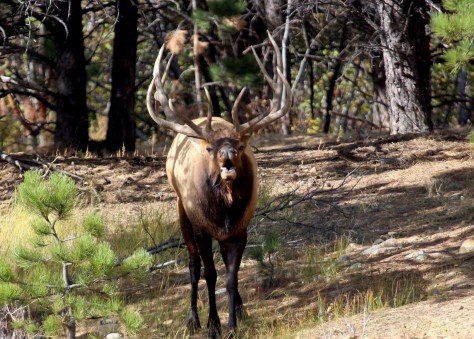
As I type this from the deck of a cabin I’ll use as base camp for a few days, I’m still a bit jittery (in a good way). It’s from the adrenaline-infused meeting I had with a big bull elk and my camera.
This bull was bugling away-despite the peak of the rut being over. (Photo by Chester Moore, Jr.)
This big boy had a bunch of cows cornered in a small lake and he let a younger bull know he wasn’t getting any play.
I was told the rut was over here but you couldn’t tell by today’s action. There was bugling, attempted mating and some straight up fighting.
Seeing this from the perspective of a bowhunter, it would have been about trying to get in and make a clean, ethical shot to score on some incredible, heart-healthy venison.
But with my photographer cap on, it was about capturing the vibe of what was going on. I think I did in a couple of shots.
Elk are truly a national treasure and to see them in such numbers and to get so close was an awesome experience. I’ve seen and photographed plenty of elk in the past but there was something special about this bull.
A cow elk playing in the water near Estes Park. Co. (Photo by Chester Moore, Jr.)
He had attitude and capturing that with my camera was a true blessing.
I have never done drugs of any kind but today I got high here in the Rocky Mountains.
The bugle of the elk and the stunning scenery took me to a higher place that will undoubtedly beckon me to return again and again.
Chester Moore
You can subscribe to this blog by entering your email address at the subscribe prompt at the top right of this page. You can contact Chester Moore by emailing chester@chestermoore.com. Subscribe to the podcast by visiting thehighercalling.podbean.com.
The tracks were so fresh I expected to see their maker appear at any second.
Nearly as wide as my two hands combined and nearly as long as my foot there was no doubt these were left by a very large black bear.
I kept my camera ready as any encounter would be up close and personal.
In a remote area of the Shasta-Trinity National Forest in northern California, I was at a stretch of river where huge boulders lined the shores, creating a rugged maze.
It was wall to wall granite with the ground being a mix of smaller rock and sand.
Reader Al Weaver captured this photo of a black bear near Bay City, TX on the coast over a decade ago. Did this bear travel from the Davis Mountains or some other Trans-Pecos location down to the coast? Or did it cross from Louisiana where a small but growing bear population lives.
The tracks that ended at a huge flat outcropping led me close to the river. The view was stunning and I took time to savor the moment but my quarry remained elusive.
An hour later I found myself a few hundred yards above this location.
Out of the corner of my eye, I caught slight movement.
Through the binoculars what looked at first like a bush turned out to be a black bear standing as if something had caught its attention too.
I am not sure if it was the same bear whose tracks I had followed.
Perhaps it had caught scent I left behind but one thing is for sure. The chill that ran down my spine at that moment reminded me of why I pursue wildlife and on this occasion wildlife might have very well been pursuing me.
After all, I was in this majestic animal’s domain.
Ursus americanus is the most abundant bear on the planet with an estimated 600,000 scattered throughout the United States, Canada and Mexico. They are a true wildlife conservation success story but not all is well.
Parts of their historic range are devoid of bear while some others are starting to see the first sign in decades.
My home state of Texas is a prime example.
Ursula americanus eremicus, the Mexican black bear, is protected from harvest in Mexico and over the last two decades they have been spilling into Texas from the Sierra Del Carmen Mountains.
Most of the population is centered around Big Bend National Park but there are verified bear sightings and road kills near Alpine and also as far east as Kerr County.
In fact, bear sightings in the Texas Hill Country have increased dramatically in recent years. One even paid fisheries biologists at the Heart of the Hills Hatchery near Ingram a visit-an area that hasn’t regularly had bear sightings in well over 100 years.
You can subscribe to this blog by entering your email address at the subscribe prompt at the top right of this page. You can contact Chester Moore by emailing chester@chestermoore.com. Subscribe to the podcast by visiting thehighercalling.podbean.com.
About 10 years ago, a man by the name of Al Weaver sent me a photo of a black bear he encountered while hog hunting with dogs.
The interesting part is that he was hog hunting near Bay City, TX in Matagorda County.
Bears inhabiting the Trans Pecos region near Big Bend National Park and slipping across the border from Louisiana and Arkansas into the Pineywoods are well documented but Bay City is far from these locations.
The dogs they were hunting with scared the bear into a tree and it was left alone while the hunt continued. The photo of this bear is above and as you can see it appears to be a a youngster.
It is most likely a male as young males will often travel far to start searching out mates but (male or female) how far did this one travel?
Lets say that bear entered Texas from Louisiana right at my home town of Orange coming across the Sabine River into the Blue Elbow Swamp which sits literally at the juncture of the Pineywoods and coastal marsh. This would also allow the closest access from Louisiana.
By car this is 155 miles which if you see the blue line would have the bear going through downtown Houston. That obviously did not happen. The straight path would lead it across the fifth largest bay system in the nation. That did not happen either.
The animal would have to at some point cross Interstate 10 or enter the wider spaces of the Sabine just south of Interstate 10 in Orange and maneuver through the coastal prairies, make its way around the Galveston Bay complex and down to Bay City.
What if the bear hailed from the Trans Pecos area-say somewhere near Big Bend in the Lajitas area? That’s a 651 mile drive for us and a 472 mile straight shot by air (or bear) covering all kinds of territory along the way from cities to hunting leases to wildlife refuges to international borders perhaps.
Some might argue this was a captive bear that was released but that is very unlikely. Another possibility this is an undocumented bear that was born somewhere in the middle perhaps in the Hill Country where sightings have spiked in recent years or even in the western Pineywoods or maybe along the coast somewhere.
Did you know there were bear hunting seasons as recently as the 1980s along the Texas coast? In my personal collection I have a hunting regulation book from 1979 that had a bear season in Chambers County and have seen others from subsequent years.
Were there really still a few bears along the coast at that time? Any scientific information is scant but it is an intriguing thought.
No matter where this bear came from its origins are interesting as they defy commonly held beliefs about bears in Texas.
This should serve as a reminder that nature still has plenty of surprises left and that bears can show up unexpectedly-even where no bears are known to roam.
You can subscribe to this blog to get updates on subjects like this by entering your email address at the top right of this page.