An Inspiring Look At Wildlife Conservation

Paul Fuzinksi of Aptitude Outdoors captured a powerful, inspiring wildlife conservation message by Higher Calling Wildlife® founder Chester Moore.

It took place at the second annual Hunt-Fish Podcast Summit.

If you love wildlife and want to do something about it future, this is a must watch.

Don’t Miss This Intense, Informative Podcast!

My new podcast Dark Outdoors has officially made its debut.

The first episode is called Apex Predators: Ted Bundy And Serial Killers in America’s Forests. And it features an interview with the New York Times best-selling author who sat across from Bundy for six months interviewing him. You can click the image below to listen.

You can listen by clicking the link here or searching for Dark Outdoors in podcast platforms like Itunes, Google Play, Spotify, Iheartradio, etc.

Dark Outdoors is brought to you by Texas Frightmare Weekend, Hog Hunt USA and Texas Fish & Game.

The mission is to save lives and make people of aware of what’s really going on. The outdoors media won’t touch this stuff and mainstream media doesn’t know how to report on it from an outdoors perspective.

You can help by sharing the episode on social media. 

I look forward to hearing your feedback. You can email chester@chestermoore.com.

Chester Moore

Email Chester at chester@chestermoore.com

Follow Chester Moore and Higher Calling Wildlife® on the following social media platforms

@thechestermoore on Instagram

Higher Calling Wildlife on Facebook

To subscribe to this blog and get weekly cutting edge wildlife news and commentary, enter your email at the prompt on the top right of the page

The Terrifying True Apex Predator In North America’s Forests

Dark Outdoors Debuts

I’m excited to debut my new media platform-Dark Outdoors. The mission is to raise awareness to human dangers, animal attacks and strange weather patterns that impact hunters, anglers, campers, backpackers and hikers.

Since you signed up for my blog you will get access to the podcast episodes a day before they are announced to the general public.

And the debut program is intense! Listen here.

It’s called Apex Predators: Ted Bundy And Serial Killers in America’s Forests. And it features an interview with the New York Times best-selling author who sat across from Bundy for six months interviewing him.

I’ve been investigating the dark side of the outdoors experience. In this photo I’m standing at the site of one of of the Moonlight Murders in Texarkana made famous by the 1977 film “The Town That Dreaded Sundown”. Our mission is to share info that can save lives. (Photo by Paul Fuzinksi of Aptitude Outdoor)

You can listen by clicking the links here or searching for Dark Outdoors in podcast platforms like Itunes, Google Play, Spotify, Iheartradio, etc.

Dark Outdoors is brought to you by Texas Frightmare Weekend, Hog Hunt USA and Texas Fish & Game.

The mission is to save lives and make people of aware of what’s really going on. The outdoors media won’t touch this stuff and mainstream media doesn’t know how to report on it from an outdoors perspective.

You can help by sharing the episode on social media. 

I look forward to hearing your feedback. You can email chester@chestermoore.com.

You can also check out darkoutdoors.com, where I have a new blog and a new video.

I’m looking forward to this journey with you through the great outdoors.

Until we meet again, remember when you head outdoors remember to pray, prepare and pack heat!

Chester Moore

Email Chester at chester@chestermoore.com

Follow Chester Moore and Higher Calling Wildlife® on the following social media platforms

@thechestermoore on Instagram

Higher Calling Wildlife on Facebook

To subscribe to this blog and get weekly cutting edge wildlife news and commentary, enter your email at the prompt on the top right of the page

Strange Boar With Gigantic Tusks-In My Neighborhood!

In Feb. 2021, a record-setting freeze hit Texas.

In the area near my home in Southeast Texas, we saw a tremendous amount of wild game movement seeking cover from the cold and water as most ponds and shallow canals were frozen.

On the second night of the freeze, I turned the corner off of a farm to market road heading toward my house. It was about 10 at night and I saw a larger boar (200 pound class) standing on the side of the road.

I slowed down, grabbed my phone and took this picture as it crossed the road.

This boar has huge tusks. But is there something strange about it’s back leg? Or is that an unusual motion blur? (Photo by Chester Moore)

This photo is taken about 1/4 mile from a high school. It’s only 1/2 mile from a neighborhood.

I’ve been talking about big hogs in suburban and urban areas for several years now. Well, here’s one that seemingly showed up in my neighborhood to say, “You’re right”.

What I noticed were the huge tusks.

By the way, here’s a dirty little secret about the tusks of boars.

When you see a boar mounted, the tusks are almost always pulled out of the jawline. Most of the tusk (2/3 or more) is in the jawline. So, when you see a mounted hog with five inch tusks, there were probably only two inches protruding the mouth.

This boar and most mounted ones had its tusked pulled out of the jawbone to make them longer for dramatic effect. (Public Domain Photo)

This hog had 3.5-4 inches of tusks protruding from its mouth.

When I got home and looked at the pic, I noticed something unusual with the back left leg of the hog. It almost looks as if its deformed.

Is that a motion blur of some kind? That’s certainly possible and I’m leaning that direction with my opinion.

Or is there some kind of weird deformity or injury here?

What are your thoughts?

Chester Moore

Email Chester at chester@chestermoore.com

Follow Chester Moore and Higher Calling Wildlife® on the following social media platforms

@thechestermoore on Instagram

Higher Calling Wildlife on Facebook

To subscribe to this blog and get weekly cutting edge wildlife news and commentary, enter your email at the prompt on the top right of the page

Higher Calling Wildlife Takes Big Honors

Higher Calling Wildlife® hosted by wildlife journalist Chester Moore on the Waypoint Podcast Network recently received some major honors.

At the Press Club of Southeast Texas Awards, Higher Calling Wildlife took top honors in the news category for the “Man Attacked By Hog” episode.

In addition, his “Wild Sheep Pandemic” public service announcement took first place in the Public Service Announcement category and was written, narrated and edited by Moore to raise awareness to the issue of pathogen/disease transmission between domestic and wild sheep.

He also took first place for the following categories:

*Chester’s program “Moore Outdoors” on Newstalk AM 560 KLVI, took first place for radio talk show for an episode he did on Texas’ desert bighorns with Froylan Hernandez, Texas Parks & Wildlife Department Desert Bighorn Sheep Program leader.

*Travel writing for “Sea Flats Safari: Seeking The Flats Slam In The Florida Keys” articles in Hunter’s Horn from the Houston Safari Club Foundation.

*Environmental writing for Chester’s in-depth work on wild turkey restoration in East Texas here at Higher Calling Wildlife®.

“It’s an honor to be recognized by a prestigious group of media professionals like the Press Club of Southeast Texas. Getting honored for broadcasting about wildlife conservation is really exciting”, Moore said.

Higher Calling Wildlife® received another major honor as the program was ranked one of the top wildlife conservation podcasts on the planet by Feedspot. In the 2021 rankings, the program (in its first year) ranked in the top 20.


“I just received an update that we are now the number 10 wildlife conservation podcast on the planet ranked by traffic, social media followers, authority & content. This kind of thing motivates me to work even harder and to use the God-given gift of communication to forward the cause of conservation,” Moore said.

Email Chester at chester@chestermoore.com

Follow Chester Moore and Higher Calling Wildlife® on the following social media platforms

@thechestermoore on Instagram

Higher Calling Wildlife on Facebook

To subscribe to this blog and get weekly cutting edge wildlife news and commentary, enter your email at the prompt on the top right of the page

Sheep Summit Inspires

There wasn’t a dry eye in the room.

Well, if there was, much restraint went into keeping them that way.

As the wild and domestic sheep disease documentary Transmission wrapped up and director and producer Jesse Bone approached the podium for questions, there was a palpable sense of urgency.

It was like the previous day’s viewing of Team Bighorn, which showed the Herculean efforts to capture, collar and test wild sheep for pathogen/disease in Idaho.

Watch Team Bighorn below.

Team Bighorn Film from Silverline Films on Vimeo.

According to movifree.orgMycoplasma ovipneumoniae (M. ovi) is a bacterial species commonly found in the nasal cavity and sinuses of apparently healthy domestic sheep and goats.

It is transmitted to wild sheep and goats (bighorn sheep, thinhorn sheep, and mountain goats) via nose-to-nose contact and, less commonly, aerosol/droplet transmission. In bighorn sheep and very likely thinhorn sheep, M. ovi has been associated with large all-aged die-offs due to pneumonia, which is often followed by years of lower lamb birth and survival rates that can have devastating population impacts.

The two films were rallying cries at a two-day summit of the Wild Sheep Foundation (WSF) and its Chapters and Affiliates in San Antonio, TX.

Hosted by WSF Affiliate, the Texas Bighorn Society (TBS), the goal was to galvanize, organize and strategize wild sheep conservation.

“Leaders and delegates of our chapter and affiliate network convene every year in a one-tent, one-campfire gathering to address challenges and opportunities for wild sheep conservation across North America and internationally,” said Gray N. Thornton, President, and CEO of WSF.

Froylan Hernandez addresses the attendees on the status of bighorns in Texas. (Photo by Chester Moore)

Experts from around the country discussed many items, ranging from fundraising to engaging use of social media, but was M .ovi was front and center.

From capture and removal plans to testing and treatment of domestic sheep herds in bighorn country, speaker after speaker tackled this topic.

Froylan Hernandez, Desert Bighorn Sheep Program Leader with the Texas Parks & Wildlife Department (TPWD), shared the latest on sheep in the Trans-Pecos.

That included drought-related issues and research showing non-indigenous aoudad carry M. ovi and are a growing threat to bighorns and other wildlife through food and habitat competition.

Taking a practical approach that considers the needs of private landowners as well as bighorns, TPWD is engaging the issue directly.

Other issues are impacting sheep as well. Thinhorns are feeling the impacts of climate change in Alaska and Canada. Migration corridors are being looked at and predation always looms as a growing threat.

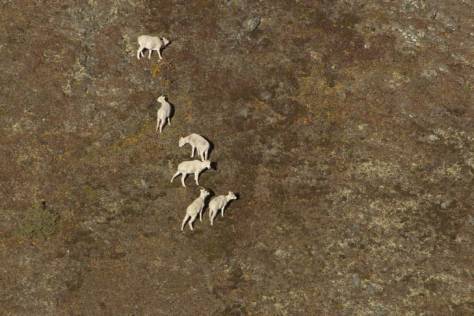
Dall sheep have experienced die-offs in several ranges in Alaska due to climate change-related issues. WSF recently concluded a thinhorn summit in the Yukon to address these and other issues facing Dall and Stone Sheep. (USFWS Photo)

The challenges are obvious, but discussion and actions taken at the summit were urgent and optimistic.

Despite recent die-offs, Texas is still just below historic (1800s) level desert bighorn populations thanks to the efforts of TPWD, TBS, WSF, and others.

New Mexico has seen a big shift in numbers to the positive over the last few decades and Mexico is experiencing a renaissance of sorts in desert bighorn sheep conservation and hunting.

Upgrade is the goal, but challenges continue to rise.

“We’re going to face those challenges and dare to do epic stuff,” Thornton said.

“We’re going to continue the legacy of putting and keeping wild sheep on the mountain and collaboratively we can make it happen in a big way.”

That was exemplified at the wrap-up dinner and auction that saw thousands of dollars raised for TBS water projects in West Texas.

A particular herd of desert bighorns has taken residence in a remote area near the Mexico border. And with current and historic drought an issue there, these projects could be lifesaving.

But that wasn’t all.

Just before the night was over, Thornton announced The Iowa Chapter of WSF sought to fund a special project in Nebraska.

Rocky Mountain bighorns in Nebraska were the recipients of funding generated from a call to action issued the last night of the summit. (Photo by Chester Moore)

A small but impressive herd of Rocky Mountain bighorns lives in the northwestern corner of the state and the goal is to translocate some to another area with suitable habitat.

With disease already an issue there, the hope is to spread healthy animals into other areas and expand the population.

More than $100,000 was raised with a $50,000 donation from WSF and the rest pledged from numerous chapters and affiliates.

It was an inspiring way to end an event that saw selfless dedication to a wildlife resource highlighted from the Yukon to Colorado and from Arizona to Wyoming.

From Stone sheep to California bighorns, no species or subspecies was left unmentioned, and each chapter and affiliate seemed focused on not only maintaining but growing sheep populations in their state.

This event was a major victory for hunter-conservationists.

It was evident without the interests of hunters and the funding that comes through WSF, its chapters, affiliates, and state/provincial/tribal sheep tags, these animals could easily slip into obscurity.

And that is inspiring because the commitment from everyone in the room was real and passionate.

And that’s a major victory for wild sheep.

For animals facing so many threats, it will take zeal and commitment to see them through.

And those two forces were alive and well at the summit.

Conservationists from the United States, Canada, and Mexico left inspired for the cause of wild sheep.

There’s much work to do but there’s a powerful group of allies to make it happen.

Chester Moore

Email Chester at chester@chestermoore.com

Follow Chester Moore and Higher Calling Wildlife® on the following social media platforms

@thechestermoore on Instagram

Higher Calling Wildlife on Facebook

To subscribe to this blog and get weekly cutting edge wildlife news and commentary, enter your email at the prompt on the top right of the page

Checking Back In (On the Road)

Greetings!

I’m checking in from San Antonio at the Wild Sheep Foundation Chapter & Affiliate Summit. Me and Lisa are having an amazing time and learning much about wild sheep conservation efforts.

We’re headed home and I’m ready to be there.

I’ve been on the road or working with kids in the capacity of our Wild Wishes® and Higher Calling Wildlife® programs.

I’ve also been working on heavily some really in-depth stories for Texas Fish & Game and recording Higher Calling Wildlife® podcasts.

It’s a busy and fruitful time.

Here are a few photos. We’ll be back with a new podcast this week and our Wildlife Wednesday update.

Chester Moore

Lisa, our daughter Faith and Chana, our special guest and the girl we’re mentoring for conservation photography and art at the YO Ranch Headquarters entrance. They were very generous to take us out on a special photograph expediton.
Chana enjoyed photographing the native and exotic wildlife at YO Ranch Headquarters. She will be working on artwork from the photos. We will auction a few off to raise funds for wildlife conservation. We will release details in the coming month.
Chanah experienced a dream come true getting to feed one of the giraffes at YO Ranch Headquarters thanks to Debbie Hagebusch.
Me and Lisa at historic Buckhorn Museum at the Wild Sheep Foundation Chapter & Affiliate Summit introductory gathering Friday.

Email Chester at chester@chestermoore.com

Follow Chester Moore and Higher Calling Wildlife® on the following social media platforms

@thechestermoore on Instagram

Higher Calling Wildlife on Facebook

To subscribe to this blog and get weekly cutting edge wildlife news and commentary, enter your email at the prompt on the top right of the page

Beast Feast, Recovering America’s Wildlife Act And More Rogue Waves

I’m looking forward to Beast Feast tonight at Ford Arena in Beaumont!

Higher Calling Wildlife will have a booth in the expo and I have the honor and privilege of getting to speak for a few minutes.

We’ve given away about 30 tickets and have a few more left. Message me if you’re interested.

It’s going to be a great event. Don’t miss!

You can get tickets here.

Recovering America’s Wildlife Act

The Recovering America’s Wildlife Act (RAWA) is currently racing through Congress with unprecedented bipartisan support. RAWA could bring $50 million to the state to help protect wildlife, restore land and give Texans more ways to enjoy the outdoors.

Help is needed to get RAWA to the finish line. The public is encouraged to contact their U.S. senators and representatives to vote “yes” for this important legislation according to officials with the Texas Parks & Wildlife Department.

On a national level, RAWA would provide $1.4 billion in dedicated annual funding for proactive collaborative efforts by state and tribal wildlife conservation initiatives to support at-risk wildlife populations and their habitats. The funding would come from existing revenues without new taxes or government programs.

State agencies throughout the country have identified 12,000 species in need of conservation assistance in federally approved State Wildlife Action Plans. These plans would help guide spending from RAWA.  Additionally, tribal nations would receive $97.5 million annually to fund proactive wildlife conservation efforts on tens of millions of acres of land. At least 15 percent of the resources would be used to recover species listed as threatened or endangered.

“The litany of ways natural resources bolster the Texas economy and improve our quality of life is seemingly endless,” said Carter Smith, Executive Director of the Texas Parks and Wildlife Department.

“Studies show property values can increase up to 20 percent when adjacent to natural areas. Natural buffers make coasts and communities more resilient to intense storms and flood events, thereby protecting our citizens and saving billions of dollars in recovery costs. While it would do much to protect fish and wildlife that need it most, the Recovering America’s Wildlife Act would also mean a long-term investment in the public health and well-being of all Texans, as well as stewardship of our home ground.”

More Rogue Waves (Wild Story!)

A few weeks ago, I mentioned research on rogue waves in bay systems and ship channels.

The response has been wild!

I will be doing a major feature in Texas Fish & Game in the July/August issue on the topic but thought I would share an account I just received here.

This one is quite intense and it comes from Dan Elder.

Two years ago on a Sunday morning my brother and I were wade fishing on the North side of the ship channel between Port Aransas and Corpus Christi.  

“We looked to our left and saw an enormous wave approaching us that seemed like a mile away.  It was a perfect wave, tall and breaking. As it approached, we could see dolphins jumping and riding the wave. It looked to be 6-10 feet tall and we thought it was some form of tidal wave.  We had no idea what we were seeing and ran toward the shore line from chest deep water.  We ran frantically because we thought we were going to die.  As we finally got to the very shallow water (10 minutes of running), the wave hit, knocking my anchored boat about 60 yards, and hitting us (who were at waters edge with a 2 or 3 foot wall of water.”

“We then looked toward Port Aransas and saw the very large ship and realized the cause of the wave.    Full cargo of oil going too fast down the channel. We called and reported the event to the Coast Guard.”

Since that time, I have seen a similar event from my boat. Same location, but wave not as large. This is a busy sea lane with many small boats and some wade fishermen.  I don’t know if there is a speed limit for these ships, but there should be because the wave created in the first incident could have easily swamped a small boat. “

After posting an article at fishgame.com asking for rogue wave stories, I got an email from David Clark, the Recreational Boater Safety Representative for the Lone Star Harbor Safety Committee in the Houston- Galveston area. 

He is also Chairman of a Working Group that was formed in early 2021 to increase recreational boater awareness of the waves generated by ships transiting the Houston Ship Channel. 

“We designed signage that will be placed at the boat ramps and other locations around the Galveston Bay Complex. The signs are being manufactured now and installation should begin in May. Currently, 5”x7” cards of the sign graphic are being displayed, along with other boating safety literature, at bait shops, marinas, fishing tackle stores, etc., in the area. The signs will have a QR code that directs people to the Recreational Boater Resources area of the Lone Star Harbor Safety Committee’s website,” he said.

As far as coastal stories go, this is in my opinion on par with the award-winning great whites of the Gulf Coast series of articles we have published. It is deeply interesting.

What’s coming in the next issue will be a truly unique look at situations too many anglers find themselves in more frequently than I even thought.

And a personal encounter with one of these rogue waves in the Sabine system is what inspired a look into the issue.

The story hopes to raise awareness and save lives.

And it might just send cold shivers down your spine.

Some of these stories are pretty intense.

Chester Moore

Email Chester at chester@chestermoore.com

Follow Chester Moore and Higher Calling Wildlife® on the following social media platforms

@thechestermoore on Instagram

Higher Calling Wildlife on Facebook

To subscribe to this blog and get weekly cutting edge wildlife news and commentary, enter your email at the prompt on the top right of the page

Powerful Program On Wild Sheep, Plus Moore to appear on “Hunting Matters”

A powerful episode of Higher Calling Wildlife-the podcast is up with Wild Sheep Foundation President & CEO Gray Thornton.

We talk in-depth about the history of wild sheep conservation, what it takes to put and keep wild sheep on the mountain and why hunters should consider getting more deeply involved in conservation.

Click to listen.

Moore To Appear On “Hunting Matters” Saturday

Check out this news release from the Houston Safari Club Foundation (HSCF).

HSCF and “Hunting Matters” welcomes Chester Moore, Editor-In-Chief of Texas Fish & Game magazine.

Chester will appear on the show this Saturday, 6am-7am CDT on KPRC AM 950 – Real Texas, Real Talk, a Houston iHeartMedia station.

Update: If you missed the show click the here to listen to the podcast.

Chester Moore is an award-winning wildlife journalist and conservationist. He is Editor-In-Chief of Texas Fish & Game magazine and contributes to Sports Afield, Hunter’s Horn, Deer & Deer Hunting, Tide, The Lakecaster and many others. He is host of “Moore Outdoors” on Newstalk AM 560 KLVI and of The Higher Calling podcast.

He is author of fifteen books including Hog Wild: Hog Hunting Facts, Tips & Strategies, Texas Waterfowl and Flounder Fever. Chester is a lifelong hunter and angler who enjoys everything from bowhunting wild turkeys to surf fishing for sharks to fly fishing for rainbow trout.

Chester Moore with Houston Safari Club Foundation Exec. Director and “Hunting Matters” host Joe Betar at the KPRC Studios.

He was awarded the Advocatus Magni Award in 2020 from the National Wild Turkey Federation for his work with wild turkeys, the Mossy Oak Outdoors Legacy award in 2017 for his work with children and wildlife and was named a “Hero Of Conservation” by Field & Stream magazine. Altogether he has won more than 150 awards for conservation, writing, radio and photography.

On the program Moore will talk about wild turkeys ranging from their life habits o conservation issues.

Follow Chester Moore and Higher Calling Wildlife® on the following social media platforms

@thechestermoore on Instagram

Higher Calling Wildlife on Facebook

To subscribe to this blog and get weekly cutting edge wildlife news and commentary, enter your email at the prompt on the top right of the page

The Importance Of Conservation (Video)

Two weeks ago, I had the honor of speaking at the second annual Hunt-Fish Podcast Summit at the Warren Ranch.

The summit is the vision of Derek York of the Impact Outdoors Podcast.

Addressing outdoors podcasters, conservation leaders and industry upstarts, the mission was to inspire conservation action and to create a NOW generation of of conservationists.

It’s probably the best speech (so far) of my career.

Check it out here and let me know what you think in the comment section below.

If you feel led, share on your social platforms and email lists.

I believe this is an important message at a critical juncture in the conservation world.

Chester Moore

Thanks to Paul Fuzinski of Aptitude Outdoors for filming and editing the speech.

Follow Chester Moore and Higher Calling Wildlife® on the following social media platforms

@thechestermoore on Instagram

Higher Calling Wildlife on Facebook

To subscribe to this blog and get weekly cutting edge wildlife news and commentary, enter your email at the prompt on the top right of the page

Wildlife Wednesday: Mega Drought Gets Worse, Asian Elephants And The Gale Force Twins

“Drought conditions are approaching 2011 levels.”

Those words shook me to the core.

Yesterday I exchanged texts with a private biologist in Texas who owns land in the Hill Country and surveys everywhere from East Texas to remote desert in the Trans Pecos.

What’s happening in my home state is bad, but it’s even worse in other places.

Source: U.S. Drought Monitor

The following is from the U.S. Drought Monitor.

Central Washington, Idaho, and northwest Montana also saw increases in drought extent or severity as short-term dryness continues to build upon long-term moisture deficits extending back to last year. Many parts of southern Idaho, and the rest of the West, have set records for the driest 3-month period (January to March) going back 100 years or more. Meanwhile near record warmth increased evaporative demand from plants and soils.

Farther south, extreme drought expanded in parts of California, Nevada, and New Mexico while moderate and severe drought expanded across Arizona. In California, Cooperative Extension reports impacts to agriculture including reduced forage, livestock stress, decreased water allocation, and the selling livestock earlier than normal. Data such as reduced stream flows and declines in satellite-based vegetation health and soil moisture indicators confirm these reports.

This is already having a big impact on wildlife. As early as last summer, wildlife officials in Nevada in conjunction with partners like The Wild Sheep Foundation were dropping water on manmade guzzlers (water tanks) to supplement water for desert bighorns and other wildlife.

Photo Courtesy Nevada Dept. of Wildlife

There are concerns across much of Texas for wild turkey and quail production in much of the state.

This will end up being the United States biggest wildlife story of 2022 and we will do our best to keep you up to date.

Helping Asian Elephants

Since 2007 I have been writing about the need to get more attention to Asian elephants and their dire conservation needs.

There are literally 10 times as many African elephants yet they seem to get the bulk of attention.

Public Domain Photo

I was excited to learn of the Center of Asian Elephant Conservation at the St. Louis Zoo.

Check out what they’re doing.

The Center for Asian Elephant Conservation’s partnership with the Smithsonian Conservation Biology Institute and others will significantly enhance our scientific understanding of rewilding elephants. Through a ground-breaking research project based in Myanmar, a framework will be developed for elephant release that incorporates a diversity of scientific approaches at all decision stages. To test this framework, approximately 30-50 elephants will be released into the wild in the near future to gain a deeper understanding of which animals are most likely to succeed in the wild and which management choices can ensure success. This project will be a tool for environmental managers to use when designing future elephant reintroduction programs across Asian elephant range countries.

Between 2005 and 2021, they contributed more than $420,000 to the International Elephant Foundation to support Asian elephant conservation in Asia and has supported projects in Sumatra, Sri Lanka, Myanmar and India.

The Zoo is also eading the fight against Elephant Endotheliotropic Herpes Virus (EEHV), a viral infection that affects elephants in the wild and in zoos, by contributing to prognosis and treatment protocols that have saved elephants. In 2021, the Zoo established its own EEHV lab to further our commitment to fighting this disease. 

You can learn more here.

An Interview With The Gale Force Twins

Growing up in South Florida, Emily and Amanda Gale, The Gale Force Twins, discovered their love and passion for the water.

Last weekend I had a chance to hang out with them and interview them for the Higher Calling Wildlife podcast at the Hunt-Fish Podcast Summit.

Photo by Chester Moore

“At an early age, we started fishing off the docks of Islamorda wanting nothing more than to go deep sea fishing. We attended the University of Miami, earning degrees in Microbiology and Immunology while competing on the track and field team as pole vaulters. The two of us spent our summer breaks and long weekends working on a busy fishing charter boat out of Key West,” they said.

“It was there that we finished our sea time, honed in on our skills and earned our USCG 50 Ton Captains Licenses. With that we started our own business, Gale Force Twins LLC.”

Listen to an inspiring interview with Emily and Amanda Gale (The Gale Force Twins

Upon graduating, the girils left the academic world to pursue careers in the sportfishing industry.

Photo Courtesy Gale Force Twins

“After a few years of running our own charter business. We began vlogging our adventures as female captains on the water. The response was exponentailly positive. We now film, edit and produce educational yet entertaining videos on YouTube, Facebook, Instagram and TikTok. Although each video is unique they all share the same goal: to Educate, Explain and Entertain. We take pride in keeping our pages family friendly while we take our viewers with us to experience the variety of fishing opportunities that the world has to offer.”

Turkey Release

The folks at Spring Creek Outdoors, LLC were kind enough to ask if I wanted to release one of the Rio Grande turkeys I had been photographing them release on the Rafter K Ranch. It was cool being on this side of a release. They are working on a TPWD-permitted turkey restoration project.

I never take moments like this for granted and thank God for them in a very literal sense.

Follow Chester Moore and Higher Calling Wildlife® on the following social media platforms

@thechestermoore on Instagram

Higher Calling Wildlife on Facebook

To subscribe to this blog and get weekly cutting edge wildlife news and commentary, enter your email at the prompt on the top right of the page