Have you ever wondered what is the most remote spot in the United States?
Well, if you have you will want to join Chester Moore and the founders of Project Remote on a fascinating program on remote locations.
In the age of “social-distancing”, this is a can’t miss show that asks the following question.
Have we developed America too much?
You can subscribe to this blog by entering your email address at the subscribe prompt at the top right of this page. You can contact Chester Moore by emailing chester@chestermoore.com. Subscribe to the podcast by visiting thehighercalling.podbean.com.
The impact of COVID-19, the coronavirus on humanity, is nothing short of historic.
While the death toll has not and hopefully will not reach the levels of the Spanish flu of 1918, the potential is there, and the grip it has on government, commerce, and private citizens is unprecedented.
That’s why I can’t help but make parallels between COVID-19 and the near-catastrophic decline of wild sheep of the 1800s.
The author photographed this bighorn at 12,000 feet in an area where grazing is restricted but these sheep don’t stay here all the time. Moving into grazing areas is a highly dangerous proposition. (Photo by Chester Moore, Jr.)
When Lewis & Clark set out on their epic expedition, there were around two million wild sheep in North America. By 1900, there were fewer than 25,000 according to some estimates.
And while it would be easy to blame it on unregulated hunting and market killing which no doubt had some impact, by far the biggest killer was disease.
The pathogen M. ovi is common in domestic sheep and quickly spreads through bighorn herds and often ends up in deadly pneumonia
Originating from , it hit wild herds as they co-mingled in the valleys and mountains during the westward expansion of European settlement. Millions of sheep died, and if it were not for conscientious hunters and fish and game departments around the nation, there would likely be no wild sheep left today.
It’s a story few have heard outside of wild sheep hunting and biologist circles, but now is the time.
Notice the mountains in the background of this sheep lot. Have wild sheep mingled with herds in this area? (Public Domain Photo)
The decline of wild sheep is second only to the government-sponsored bison slaughter in the depth of impact on a species in North America.
Humans are now quarantined, and in effect, bighorns are in many areas.
In 2016, Colorado Parks & Wildlife (CPW) officials killed six bighorns because backpackers saw them co-mingling with domestic sheep. The bacterial form of pneumonia can be brought back to the herd and transmitted to lambs.
“When you have the lambs dying, it’s hard to build a population,” said CPW spokesman Joe Lewandowski in The Durango Herald.
“As wildlife managers, we look at populations, not individual animals. In this case, we know an individual animal could spread the disease to the larger herd, and then we have a bigger problem.”
This is not an uncommon practice in wild sheep management.
While translocations, strict herd management, and grazing restrictions have brought sheep numbers continent-wide into the 150-175,000 range, pneumonia is still the most significant threat. Still, there are no specials on Animal Planet or Nat Geo Wild or any other mainstream media outlets. This pandemic has been going on with wild sheep for 150 years, and only the hunting community, fish and game agencies, and biologists seem to care.
The focus should now be on saving people and the economies of the world, but there is space to teach a valuable lesson on wildlife conservation. There has never been a point in recent history where this particular story of wild sheep has such a great chance to touch the hearts of millions of wildlife enthusiasts.
During the downtime from work and school, people are looking for things to occupy their time and inspired, informative media on some of the beautiful animals in North America can help fill some of that void.
That is what this post is all about. I’m doing my best to let people know that when the dust settles on COVID-19 (and me and my family are praying daily that will happen soon), sheep will still have their own pandemic to face.
Concerned conservationists have done a remarkable job building herds throughout North America, but these conservationists are aging quickly, and new blood needs to step up to the plate.
Maybe something good that can come out of this tragedy is that some young person is motivated to get involved with sheep conservation. Perhaps being isolated, afraid of mingling with others and under the potential threat of death itself because of an unseen force will inspire action.
Sheep, of course, have no way to conceptualize these things, but they don’t need to when caring conservationists are in place in fish and game departments, conservation groups, and halls of the legislature.
COVID-19 may be momentarily stealing our freedoms, but it can’t rob the wild and enduring spirit of those thoughtful enough to make a bold stand for bighorns and their thinhorn cousins.
That force is as majestic as the sheep themselves.
Chester Moore
You can subscribe to this blog by entering your email address at the subscribe prompt at the top right of this page. You can contact Chester Moore by emailing chester@chestermoore.com. Subscribe to the podcast by visiting thehighercalling.podbean.com.
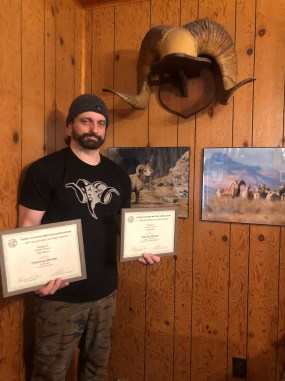
Wildlife journalist Chester Moore has been honored for his writings on bighorn sheep hunting and conservation.
He won first place for the “Outdoors Column ” category in the Texas Outdoor Writers Association Excellence in Craft awards for his bighorn sheep story entitled “New Life For New Mexico’s Bighorns”. The story appeared at Higher Calling and in the Wild Sheep Foundation’s Mountain Minutes newsletter.
Moore at home with his two “Excellence In Craft” awards.
He also received a second place award in the “Feature” category for his “Desert Homecoming” story in Sports Afield that detailed the comeback of Texas’ desert bighorn herd.
“I’ve been doing a lot on wild sheep, trying to get the word out on their conservation needs and the absolute triumph that hunter-based conservation has been for all wild sheep in North America. It’s a real honor to be recognized for these writings.”
Moore is a staunch supporter of sheep and mountain wildlife conservation is a member of The Wild Sheep Foundation, Texas Bighorn Society and Rocky Mountain Bighorn Society as well as the Rocky Mountain Goat Alliance. He is also a member of The Houston Safari Club Foundation and National Wild Turkey Federation.
Additionally, in January at the National Wild Turkey Federation-Texas state convention Moore was awarded the “Advocatus Magni” award for his work as an advocate for wild turkey conservation.
Chester won the “Advocatus Magni Award” from the National Wild Turkey Federation for his work as an advocate of wild turkey conservation.
“This is such a tremendous honor,” Moore said.
“Wild turkeys are a passion of mine and I believe if we get turkey conservation right all forest species will benefit. Even wild sheep benefit from certain turkey enhancement projects like controlled burning. To get an award like this is truly inspiring.”
You can subscribe to this blog by entering your email address at the subscribe prompt at the top right of this page. You can contact Chester Moore by emailing chester@chestermoore.com. Subscribe to the podcast by visiting thehighercalling.podbean.com.
Spoken somberly from a National Forest Service game warden, those words got my attention.
As we conversed at the National Wild Turkey Federation convention in Nashville, I asked if he ever worked Humboldt County, Ca.
And as I related a personal experience from there nearly 20 years ago, he recommended the six-part Netflix series.
“There are missing people, murders and drug trafficking. You were lucky to get out,” he said.
In 2002 me and my father set out on a mission to explore the Pacific Northwest after my great white shark cage dive adventure in San Francisco. I had heard a bit about pot growers in the area but nothing that seemed worse than where I live in East Texas.
Boy was I wrong.
One night on our trip we set out to try out our new night vision goggles and to record night wildlife sounds in the stunningly beautiful mountains in the Trinity Alps. When I tell you this was in the middle of nowhere it might be hard for you to imagine just how far unless you’ve been to that part of the world.
We pulled up a few minutes after the sunset and planned to stay through the night.
As Dad started taking out the equipment, I walked over to a good viewing spot to look down into the valley with the night vision goggles.
The moon was full so visibility was high.
If anything came into the clearings below we should get a glimpse, I thought.
Then I saw it.
A beam of light shot up toward our position.
“Dad, did you see that?” I asked as I pulled off the goggles.
“What?”
“A light beam just shone toward us,” I replied.
“I didn’t see it,’ he said.
Neither did I now that the goggles were off.
I put them back on, and a few seconds later I could see the light beam moving up toward us. I took them off and couldn’t see the light.
Immediately I knew that someone was below, traveling with night vision and using an infrared light only visible with night vision technology.
The drug activity warning hit me and I readied to retreat. I knew whoever was down there was not listening for bugling elk like we were.
Just as I shouted for Dad to throw the gear back in the SUV, headlights of a vehicle came on about 3/4 mile ahead of us.
We were on one side of a logging road that cut across a mountain.
This was on the other side of the mountain road. Someone had been signaled.
We shoved our gear into the SUV and sped out of there, but by the time we hit the road so did the truck from the other side. They were headed straight for us. At one point I was going 80 down the mountain, and they were just a few feet away—literally an arm’s length from hitting us.
I knew that was their goal.
After what seemed like forever we got to the base of the mountain on one of the main roads going toward Willow Creek. As soon as we turned back toward that little city, they turned back up the mountain.
The author finds himself in remote locations frequently. And while they are often beautiful like this aspen-covered hill in the Rockies, danger often lurks. The biggest game is usually in the most remote locations and sometimes so are the most evil people.
Had I not went with my gut feeling, we might have been killed or at least gotten into a very tense situation.
Well, being chased down a mountain is pretty tense, isn’t it?
Over the years I have learned a few things about staying safe in the woods from people with bad intentions. Please share this with others.
It could save their lives.
#Bad Vibes: If you feel bad about going into an area don’t go. I am a follower of Christ. I believe sometimes this is the Holy Spirit telling me to stay away. You may not believe that, but just call it a “gut feeling” and go with it.
#Never Alone: As much as I love to be in the distant forest alone with my camera—don’t you do it. Always bring someone along. Preferably someone who is experienced in the woods. You are far more likely to get hurt by evil people if you are alone.
#Pack Heat: If it’s legal where you are then use your Second Amendment right, and carry a firearm. Make sure you are trained in its use and be prepared to do what is necessary.
Better you defend yourself against a maniac than become a statistic. Also, carry a large knife with you. In close quarters it could save your life.
#Study the Area: The Internet is a great tool for studying areas. If you find out an area is a high drug trafficker area for, for example; avoid it like the plague.
Stay away!
I have several areas I no longer frequent because of this issue.
#Stay Calm: If you do encounter people in the woods who seem uneasy or a bit shifty, stay calm. Getting angry or showing fear is a good way to trigger someone who has violent tendencies.
#Travel Plan: Leave your spouse or close friends a travel plan and let them know the points you plan to explore. Give them a time frame. Let them know to call for help if you have not returned by a certain time or day.
#Strategic Parking: Always park your vehicle facing out of the area as you check out. In a tight spot, you don’t want to have to back up and turn around during a retreat. Also park in a spot in a clear area that you can see from a distance. If someone is waiting on you or has moved into the spot, it will give you a chance to assess the situation and prepare.
#Don’t Try to be a Hero: If you see strangers poaching in the woods at night for example, don’t be a hero and try to stop them. They are armed and probably will use their weapons on you if you try to stop them. Call and report activity to local game wardens and get out as quickly as possible.
#Buy And Carry A Beacon: I carry a Spot-X beacon that will alert all rescue personnel at the touch of a button. Don’t rely just on a cell phone. Get a beacon of some kind too.
#Talk To Locals: Not all information is on social media. Talking to locals in a gun shop or sporting goods store can give you good intel on the local region.
Seeking wildlife in the mountains and forest is one of the most exciting things a person can do, but it has its share of dangers. Keep these tips in mind and you should be available to avoid any serious trouble.
After studying a map, I was probably 10 miles or so from the actual Murder Mountain documented in the series but deep in a county with many missing people, murders and mayhem.
Do you have any harrowing stories of running into dangerous people in the woods? If so, email me at chester@chestermoore.com.
You can subscribe to this blog by entering your email address at the subscribe prompt at the top right of this page. You can contact Chester Moore by emailing chester@chestermoore.com. Subscribe to the podcast by visiting thehighercalling.podbean.com.
It’s a name that invokes horror some 40 years after this despicable reign of terror.
And that was the name carved into a tree deep in a national forest in Utah where Josh Slone was bowhunting mule deer.
“It was an old inscription and it was chilling, especially knowing Bundy lived in Utah and killed people there,” Slone said.
There are other alleged Bundy tree carvings but this one was far, far off the beaten path.
Had one of the most evil people who ever walked the planet actually carved that into the tree?
There is no way to tell but there is no question that bad people often do the worst things in remote places.
A couple of years ago someone asked me what was the most dangerous thing to encounter in the woods.
Since I’ve written and broadcasted extensively on cougars, snakes, feral hogs and bears they were expecting one of those as the answer.
“People, ” I said.
“There is nothing more dangerous than people, especially in remote forests and mountainous regions.”
Deep woods can sometimes mean big dangers. (Public Domain Photo)
The answer came from collecting stories as a journalist over the years and my own personal experiences which I will discuss in upcoming posts and broadcasts.
The stories are omnipresent.
Take for example the caller to my radio program “Moore Outdoors” on Newtalk AM 560 KLVI who found a body burning while teal hunting with his son south of Houston.
Another caller revealed that in the 70s he and his father were out night fishing near High Islalnd, TX and see someone against the shoreline burying something and decided to leave.
Remote areas are often the most peaceful but due to the isolation can be extremely dangerous.
The author often finds himself in very remote locations. Here he glasses for bighorn sheep in a remote valley in Colorado.
My goal is to educate people on what can happen in these areas and how to be prepared so that all deep woods hunting, fishing and wildlife viewing trips are safe.
That will require bringing to light some uncomfortable facts. And it will also involve creating a system of proactive safety.
I see these human-related threats falling into four categories.
*Idiot Hunters: These are those rare , unethical, clueless hunters who should not be in the woods (and give the rest of us a bad name). Every years stories of people shooting someone because they heard something coming through the bushes. This is probably statistically the most dangerous human threat because of the widespread nature of hunters in America.
*Poachers: Encountering a poacher in the woods can be dangerous if they assume you will turn them in or if you make the mistake of confronting them instead of law enforcement handling the duties. It’s not as dangerous as it is in Africa where organized crime and even terror cells are involved in high stakes rhino and elephant poaching but it is a potential threat.
*Drug Trade: Finding meth labs and pot farms is not good. People do not want their operations found out and will go to any length to stop someone from squealing.
*Predators: This is the highest level. This is coming across someone hunting humans whether to rape, kill or terrorize.
There is no way to tell if the Bundy inscription at the beginning of the story was actually made by that monster but think about what would happen if you had stumbled upon him carving into a tree with knife in hand.
Would you be ready to defend yourself? Would you even be suspect of this person?
There are lots of questions that need answering and we will do that here and on my other media platforms throughout 2020.
Chester Moore
You can subscribe to this blog by entering your email address at the subscribe prompt at the top right of this page. You can contact Chester Moore by emailing chester@chestermoore.com. Subscribe to the podcast by visiting thehighercalling.podbean.com.
The Wildlife Journalist® and Higher Calling blog publisher Chester Moore was awarded the National Wild Turkey Federation’s (NWTF) “Advocatus Magni Award” for being an outstanding advocate of wild turkey conservation and hunting.
Moore received the award at the NWTF Texas banquet in College Station, TX and said it a true honor to be recognized by such a prestigious organization and for something he believes in wholeheartedly.
“As turkeys go, so do America’s forests. If we get turkey conservation right then everything from whitetail deer to gopher tortoises and wild sheep benefit,” he said.
In 2019 Moore embarked on a quest to raise awareness to turkey conservation and began by photographing the Grand Slam of turkeys around the nation in one year.
Two Rio Grande gobblers the author photographed on his Turkey Revolution® quest in 2019.
“There’s much more to come. This award inspires me to do even more and explore things like the link between turkeys and sheep in their shared range. It’s going to be a great year,” he said.
The highlight will be taking a group of teen’s from Moore’s Wild Wishes® program into Colorado on a search for wild sheep, turkeys and elk in the mountains.
These Higher Calling Wild Wishes Expeditions will take these young people who have a critical illness or loss of a parent or sibling on a special conservation mission trip to raise awareness to sheep, turkey and elk habitat and conservation issues.
You can subscribe to this blog by entering your email address at the subscribe prompt at the top right of this page. You can contact Chester Moore by emailing chester@chestermoore.com. Subscribe to the podcast by visiting thehighercalling.podbean.com.
For Immediate Release—Wild Wishes® grants wildlife encounters to children and teens with a critical illness or loss of a parent or sibling.
Part of the outreach of Chester and Lisa Moore’s nonprofit Kingdom Zoo Wildlife Center® outreach, the 100th child received a life-changing wildlife encounter in Sept. 2019.
Chester and Lisa Moore in Colorado scouting for location for Higher Calling Wild Wishes Expeditions.
Higher Calling Wild Wishes Expeditions goes to a new level by taking teens from the program on expeditions to teach wildlife conservation through mentorship in wildlife photography, social media awareness raising and fundraising skills.
“We noticed that many of the young people we work with who face these great challenges are looking for a way to help and give back. We are creating these opportunities to give young people an avenue to not only understand conservation but a way to get involved,” said Chester Moore.
Reannah fits a radio collar on a desert bighorn sheep at Elephant Mountain Wildlife Management Area courtesy of the Texas Parks & Wildlife Department.
Two pilot projects initiated the program in 2019.
Wild Wishes girl Reannah changed her degree and school (now a Texas Tech student) to work with conservation after her wish encounter as a high school senior in 2018.
“It give me even more inspiration to pursue a career in working in wildlife conservation.”
Wild Wishes boys Amos and Jaxon got to take part in a special catch-and-release conservation mission for Guadalupe bass in west-central Texas. The trip was featured in Texas Fish & Game magazine and the boys learned how using the photos they took on the trip could raise awareness to problems facing stream fisheries.
Jaxon was excited to catch his first-ever Guadalupe bass
Special challenges usually disqualify young people for experiences like this. We are creating special opportunities for them only.
In 2020 we are doing our first expeditions into Yellowstone, Rocky Mountain National Park as well as our second annual Guadalupe bass trip.
Can you help sponsor one of these trips? Any size donation is appreciated.
You can subscribe to this blog by entering your email address at the subscribe prompt at the top right of this page. You can contact Chester Moore by emailing chester@chestermoore.com. Subscribe to the podcast by visiting thehighercalling.podbean.com.
You can subscribe to this blog by entering your email address at the subscribe prompt at the top right of this page. You can contact Chester Moore by emailing chester@chestermoore.com. Subscribe to the podcast by visiting thehighercalling.podbean.com.Elephant Mountain Wildlife Management Area (WMA)—The chuffing sound of helicopter blades sounded faintly in the distance.
As a crowd of biologists and technicians from the Texas Parks & Wildlife Department (TPWD), Tech Tech, and Sul Ross University, among others, looked upward, the helicopter appeared.
Flying above the 6,2000-foot peak of Elephant Mountain in this remote area of Brewster County, it looked blurry at first.
A pair of bighorns is safely brought to the ground as the sun rises over Elephant Mountain in Brewster County, TX. (Photo by Chester Moore, Jr.)
But upon approach, details became apparent, and so did it’s cargo.
Two desert bighorn sheep blindfolded and secured in safety gear hung from the helicopter and were soon gently placed on the ground.
After detachment, the ground crew quickly moved the sheep to tables to thoroughly examine them.
They gave the sheep everything from fecal examinations to blood tests and took tiny ear clippings for DNA records.
“I can’t believe I’m getting to see all of this,” said Reannah Hollaway, a first-year wildlife student at Texas Tech.
Reannah is part of our Wild Wishes® program that grants wildlife encounters to youth struggling with critical illness or loss of a parent or sibling.
As a high school senior, Reannah’s initial wish was to encounter sea turtles. But while attending her first school of choice in 2018, she reflected on her wish experience and decided to go into the conservation field.
In fall 2019, she transferred to Texas Tech and now dreams of working on behalf of wildlife.
When TPWD”s Project Leader of Trans Pecos WMAs, Mark Garrett, approached her with a GPS collar in hand, she wasn’t quite sure what was happening.
But as officials brought in a big ram, she realized she was getting to put collar it.
“This will give us much information on its movements and allow us a better understanding of what these sheep are doing after we move them to Black Gap Wildlife WMA,” Garrett said.
Reannah fits a radio collar on a desert bighorn ram. (Photo by Chester Moore, Jr.)
After overcoming a few understandable nerves, Hollaway enthusiastically fitted the collar and watched as the crew moved the ram into a transport trailer.
In the course of the next few hours, she took ear clippings and helped take a blood sample from several ewes.
Desert bighorn sheep restoration in Texas in many ways centers on Elephant Mountain WMA. Donated to TPWD in 1986 for sheep propagation, it has been highly productive for desert bighorns, and when the area reaches carrying capacity, TPWD officials move part of the herd to other locations that could use a population boost.
These efforts supported by groups like the Texas Bighorn Society, Wild Sheep Foundation, and Dallas Safari Club have seen bighorns reach a population of around 1,500 in the Trans Pecos.
And after years of importing sheep from states like Nevada, TPWD offcials are now able to use Texas sheep to stock available habitat.
These ewes are tagged, collared and ready for release at Black Gap WMA. (Photo by Reannah Hollaway)
“It’s exciting to see how so many people have rallied around the bighorn program, and we are always excited to be able to take sheep from one place to another to expand their range in the Trans Pecos,” said Froylan Hernandez Texas desert bighorn program leader.
While scanning the area for photo opportunities, I noticed Reannah looking into one of the transport trailers.
“He’s beautiful, and his number is 8,” she said, referring to the identifying ear tag.
“I think I’ll name him Brian. He looks like a Brian.”
“Brian” the bighorn-aka No. 8 is trailered and ready to be released at Black Gap WMA. (Photo by Chester Moore, Jr.)
The young lady looked at the gorgeous ram in awe, and in her eyes, I could see the same wonder that has kept me enthused about wildlife since I was a little boy.
When business is slow, assignments are challenging, and real-life issues settle in, these moments are what keeps someone who works with wildlife motivated.
As me, my wife Lisa and daughter Faith made the eight-hour trek from Alpine to the Houston area to bring Reannah home; the happenings of the day dominated the conversation.
The sheep were beautiful.
The people were kind and gracious.
The helicopter operation was incredible to witness.
And Reannah getting to take part in this process was unforgettable and inspired a young lady to move forward in her studies and life with enthusiasm.
Ancient pictographs created by first nations people like the Jornada Mogollon of Texas and Fremont Culture of Utah adorn rock walls and caves in the desert Southwest.
Bighorn images inscribed on rocks in Utah by the Fremont culture. (Photo courtesy National Park Service)
Among these rock paintings are striking images of bighorn rams.
It is not clear whether these first nations people hunted sheep, but their reverence was evident.
Today desert bighorns still inspire.
Whether it is wildlife journalists like myself, wildlife biologists, hunters, landowners, or an aspiring student like Reannah, these animals leave an imprint on the human spirit.
Their mere presences move us to make the world a better place for sheep and other wildlife.
My daughter Faith excitedly proclaimed those words as she cracked open a box and released an Eastern turkey into the wilds of Titus County, TX.
We went to document the release for this blog and Texas Fish and Game and she got a chance to participate courtesy of the Texas Parks & Wildlife Department (TPWD) and National Wild Turkey Federation (NWTF).
An eastern turkey flies into its new habitat in Titus County, TX. (Photo by Chester Moore, Jr.)
To say she was pumped was an understatement.
This bird was one of 21 brought in from Missouri over a two-day span to kick-off what TPWD calls a “super stocking”.
A “super stocking” involves releasing a minimum of 80 turkeys at each site over time with the ideal ratio of three hens for each gobbler.
In the past, TPWD released smaller numbers in area but have over the last decade went to larger stockings and are seeing more success.
“It’s the same old story,” said TPWD turkey program director Jason Hardin.
A Rio Grande gobbler the author photographed in Kerr County, TX. Rio Grandes were originally stocked in East Texas but they did not fare well. (Photo by Chester Moore)
“The birds were essentially wiped out by subsistence and market hunting along with extensive habitat loss in the later parts of the 19th century, but with the help of the NWTF, we have been able to bring the birds back all across the country. Although more than 50 counties in East Texas were stocked during the 1980s and 1990s only 28 counties are open for turkey hunting today. So we had to start looking at why we were not as successful in keeping the Eastern wild turkey population flourishing as other states in its historic range.”
I have been talking turkey with hunters in East Texas since these super stockings began and have many reports of increased turkey numbers in the counties where they have taken place.
Stockings attempts in the 1970s involved releasing Rio Grande birds as well as pen-raised Easterns but both failed to gain traction.
Now TPWD only releases wild-caught Eastern turkeys from states like Missouri, Georgia, Mississippi and North Carolina.
They give a $500 donation to participating state wildlife programs for each bird that comes from upland game bird stamp sales. Transportation and other fees are covered by NWTF.
For an extremely in-depth discussion on this topic listen to the podcast of my radio program “Moore Outdoors” on Newstalk AM 560 KLVI as I talk with Annie Farrell of NWTF.
It’s an inspiring program that will hopefully see eastern turkeys eventually flourish in a much greater part of their East Texas range.
We will have much more on this topic in 2020 but for now enjoy the video and knowing that turkey stockings are returning to more areas in the Pineywoods of East Texas.
Chester Moore
You can subscribe to this blog by entering your email address at the subscribe prompt at the top right of this page. You can contact Chester Moore by emailing chester@chestermoore.com. Subscribe to the podcast by visiting thehighercalling.podbean.com.
In March 2019 I began a quest to capture quality photographs of Rio Grande, Merriam’s, Eastern and Osceola turkeys-all within 2019.
The idea is to raise awareness to turkey conservation. I call this project Turkey Revolution!
Hunters (like myself) call this quest the Grand Slam.
And while I took a few hunts this year including bagging my first eastern in New York, this quest is to document with a camera these great birds and to share the experiences through my various media platforms like this blog, Texas Fish & Game, Newstalk AM 560 KLVI and The Wildlife Journalist®.
I happy to announce I wrapped up year one of this adventure in Colorado photographing Merriam’s turkeys.
I got photos of numerous birds there including a very special one-a cinnamon-colored bearded hen you can see a brief clip of in the video below.
Also check out this photo of another beautiful Merriam’s I found in Colorado and a shot of a distant flock I got on a return trip in October on a snow-covered mountain.
The author photographed this Merriam’s turkey in Colorado at an elevation of 7,000 feet. (Photo by Chester Moore, Jr.)
Merriam’s turkeys bundled up after the first snow in Estes Park, Co. in Oct. 2019. (Photo by Chester Moore, Jr.)
This has been a truly exciting adventure and 2020 looks to be equally as interesting as we are in touch with the top biologists, wildlife managers and hunters around the nation on the issue of turkeys.
Thank God for the turkey on the table, but most of all those in the woods and on the mountains.
And don’t forget to say a prayer for all of the wild things.
Chester Moore
You can subscribe to this blog by entering your email address at the subscribe prompt at the top right of this page. You can contact Chester Moore by emailing chester@chestermoore.com. Subscribe to the podcast by visiting thehighercalling.podbean.com.